
Every Click Tells a Story-Are You Listening?
Imagine spending thousands of dollars on advertising, email campaigns, and social media promotions only to wonder why sales aren’t growing. Many ecommerce businesses collect large amounts of data every day, yet they struggle to turn that information into meaningful decisions.
That’s where ecommerce data analytics becomes a game changer.
Instead of relying on assumptions, ecommerce data analytics helps you understand how visitors interact with your store, which products generate the most revenue, where customers abandon their shopping carts, and which marketing channels deliver the highest return on investment.
Whether you’re running a Shopify store, WooCommerce website, or a multi-channel ecommerce business, analyzing the right data can help you optimize every stage of the customer journey and make smarter decisions that lead to sustainable growth.
In this guide, you’ll learn how ecommerce data analytics works, which metrics truly matter, and how customer insights can help increase conversions and revenue.
Table of Contents
- What Is Ecommerce Data Analytics?
- Why Ecommerce Data Analytics Matters
- Benefits of Ecommerce Data Analytics
- Key Ecommerce Metrics Every Business Should Track
- How Customer Insights Drive More Sales
- Best Tools for Ecommerce Data Analytics
- Common Mistakes to Avoid
- Best Practices for Smarter Tracking
- Conclusion
- Frequently Asked Questions
What Is Ecommerce Data Analytics?
Ecommerce data analytics is the process of collecting, measuring, and analyzing data from your online store to understand customer behavior, sales performance, and marketing effectiveness.
Instead of looking at numbers in isolation, analytics connects data from multiple sources, including:
- Website traffic
- Sales performance
- Customer behavior
- Marketing campaigns
- Product performance
- Inventory
- Customer support
This unified view helps businesses identify opportunities, fix bottlenecks, and improve profitability.
Why Ecommerce Data Analytics Matters
Today’s online shoppers interact with multiple touchpoints before making a purchase.
A customer may:
- Discover your brand through Google
- Read product reviews
- Visit your website several times
- Open marketing emails
- Click a Facebook advertisement
- Finally complete a purchase
Without proper analytics, understanding this journey becomes difficult.
With ecommerce data analytics, businesses can answer questions like:
- Which marketing channel drives the highest revenue?
- Which products convert the best?
- Why are customers abandoning carts?
- Which pages cause visitors to leave?
- What customer segments generate repeat purchases?
These insights help businesses invest in strategies that produce measurable results.
1. Better Customer Understanding
Analytics reveals:
- Buying habits
- Shopping preferences
- Product interests
- Device usage
- Geographic location
- Purchase frequency
This information enables personalized shopping experiences.
2. Higher Conversion Rates
Understanding where visitors drop off allows businesses to improve:
- Checkout process
- Product pages
- Navigation
- Mobile experience
- Calls-to-action
Small improvements often result in significant increases in sales.
3. Smarter Marketing Decisions
Rather than increasing marketing budgets blindly, businesses can identify campaigns generating the highest ROI.
Analytics helps optimize:
- Google Ads
- Facebook Ads
- Email marketing
- Organic SEO
- Affiliate campaigns
Knowing which products sell quickly helps prevent:
- Overstocking
- Stockouts
- Lost sales
- Excess inventory costs
5. Increased Customer Retention
Customer acquisition is expensive.
Analytics helps businesses identify loyal customers and build retention campaigns that increase lifetime value.
Key Ecommerce Metrics Every Business Should Track
| KPI | Why It Matters |
|---|---|
| Conversion Rate | Measures how many visitors become customers |
| Revenue | Tracks overall business growth |
| Average Order Value (AOV) | Shows how much customers spend per purchase |
| Customer Lifetime Value (CLV) | Estimates long-term customer value |
| Customer Acquisition Cost (CAC) | Measures marketing efficiency |
| Cart Abandonment Rate | Identifies checkout problems |
| Return on Ad Spend (ROAS) | Evaluates advertising performance |
| Bounce Rate | Indicates landing page effectiveness |
| Repeat Purchase Rate | Measures customer loyalty |
| Revenue by Channel | Shows best-performing marketing channels |
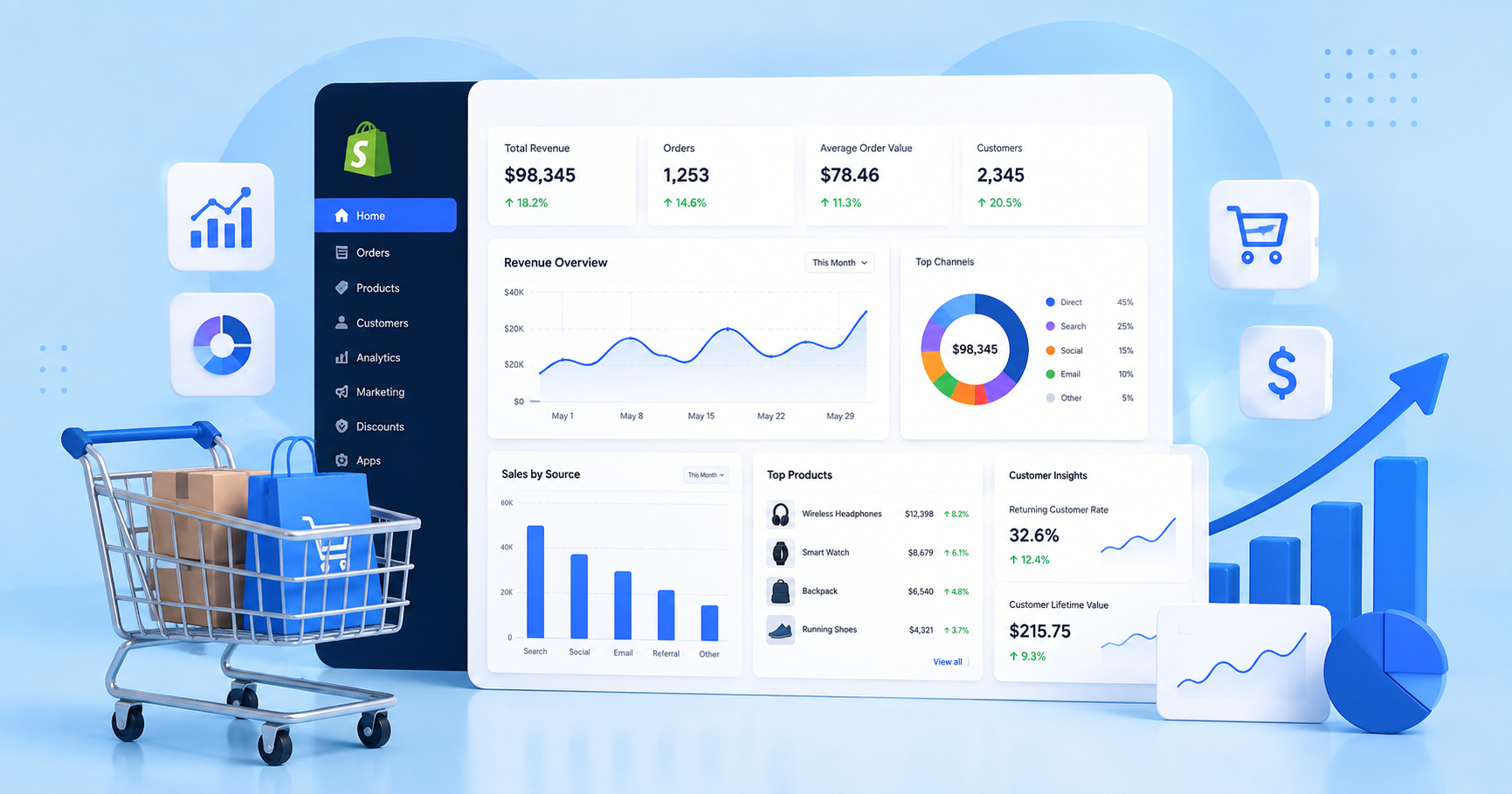
Instead of monitoring dozens of reports, many businesses use dashboards to view these KPIs in one place.
Data becomes valuable when it explains customer behavior.
For example:
Analytics shows that mobile users abandon checkout more frequently than desktop users.
Action: Simplify the mobile checkout experience.
Result:
- Higher mobile conversions
- Lower abandonment
- More revenue
Customers frequently purchase two products together.
Action: Create bundle offers.
Result:
- Increased Average Order Value
Email campaigns generate the highest repeat purchases.
Action: Invest more in lifecycle email marketing.
Result:
- Improved customer retention
- Higher revenue
Best Tools for Ecommerce Data Analytics
Several platforms help businesses track ecommerce performance.
Popular options include:
- Google Analytics 4
- Shopify Analytics
- Adobe Analytics
- Looker Studio
- Microsoft Power BI
- Tableau
- StatNexa
- Triple Whale
The best solution depends on your reporting needs, integrations, and business size.
Common Mistakes Businesses Make
Tracking Too Many Metrics
Not every metric drives growth.
Focus on KPIs connected to business goals.
Ignoring Customer Segmentation
New visitors behave differently from returning customers.
Segmenting audiences leads to more accurate insights.
Relying on Manual Reports
Manual reporting wastes time and increases errors.
Automated dashboards provide faster, more reliable insights.
Analytics is only valuable when insights lead to improvements.
Review reports regularly and test changes based on findings.
Best Practices for Smarter Tracking
Set Clear Business Goals
Track metrics that align with objectives such as:
- Increasing revenue
- Improving retention
- Reducing cart abandonment
- Growing average order value
Build a Unified Dashboard
Combine marketing, sales, website, and customer data into a single dashboard for easier decision-making.
Monitor Performance Regularly
Review reports weekly or monthly to identify trends before they become problems.
Segment Your Audience
Analyze performance based on:
- Traffic source
- Device
- Customer type
- Geographic region
- Product category
Use Predictive Insights
Modern analytics platforms leverage AI to forecast trends, helping businesses anticipate demand and optimize campaigns proactively.
Conclusion
Growing an online business requires more than attracting visitors—it requires understanding what those visitors do and why. Ecommerce data analytics transforms raw numbers into actionable insights, helping businesses improve customer experiences, optimize marketing spend, and increase revenue with confidence.
By focusing on meaningful KPIs, tracking the customer journey, and using centralized dashboards, you can identify opportunities that might otherwise go unnoticed. Whether you’re refining your checkout process, personalizing marketing campaigns, or measuring the impact of every sales channel, data-driven decisions consistently outperform guesswork.
The most successful ecommerce brands don’t just collect data—they use it to adapt, innovate, and grow. Start tracking smarter today, and you’ll be better equipped to turn customer insights into lasting business success.
Frequently Asked Questions
What is ecommerce data analytics?
Ecommerce data analytics is the process of collecting and analyzing data from online stores to improve sales, marketing, and customer experiences.
Why is ecommerce data analytics important?
It helps businesses understand customer behavior, optimize marketing campaigns, improve conversion rates, and make informed decisions based on real data.
Which ecommerce metrics should I track?
Focus on conversion rate, revenue, average order value, customer lifetime value, customer acquisition cost, cart abandonment rate, and return on ad spend.
How often should ecommerce data be analyzed?
Review key metrics weekly for operational insights and monthly for strategic planning. High-traffic stores may benefit from real-time dashboards.
Can small businesses benefit from ecommerce analytics?
Absolutely. Even small online stores can use analytics to understand customer behavior, identify growth opportunities, and improve marketing efficiency without large budgets.