
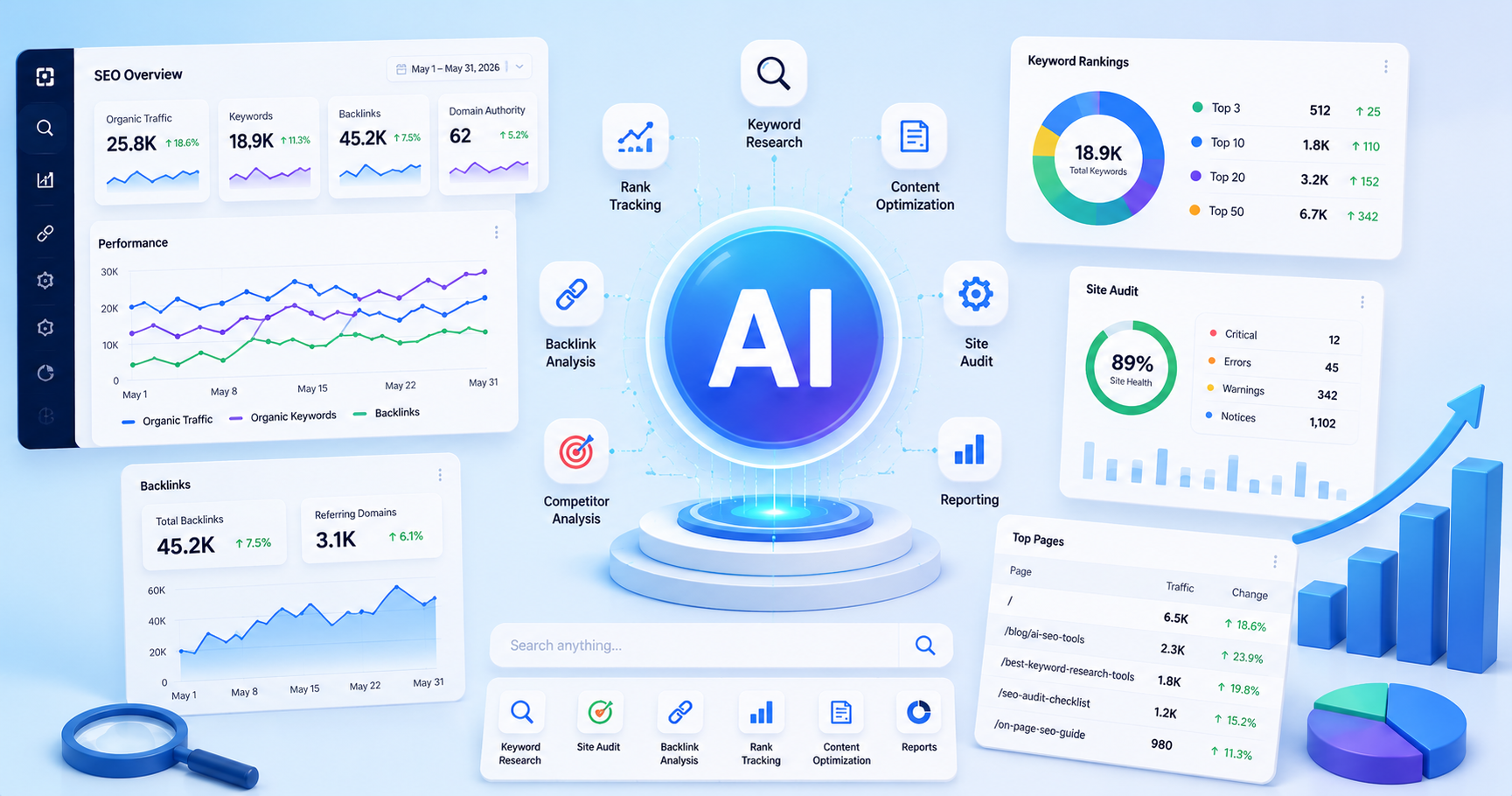
Ranking on Google isn’t as simple as publishing a blog post anymore. Search engines have become smarter, competition has grown, and users expect high-quality, helpful content. At the same time, AI has changed how marketers research keywords, optimize content, analyze competitors, and improve search performance.
Instead of hours of manual SEO work, companies are using AI-powered tools to work more quickly and make better decisions. Use these platforms to discover keyword opportunities, receive recommendations for content improvements, track rankings, find technical issues, and automate repetitive workflows.
But with dozens of options available, it’s not easy to find the right solution. Some tools are good for keyword research, some are good for content optimization, some are good for technical SEO, some are good for reporting and some are good for competitor analysis.
In this guide, we’ve compared the best AI SEO tools for agencies available in 2026 to help you find the right platform for your goals. Whether you’re an agency working with multiple clients, a freelancer looking to scale your business or an in-house marketing team looking to improve search visibility, you’ll find a tool that fits your workflow and budget.
We’ll compare each platform based on features, pricing, strengths, limitations, and ideal use cases so you can make an informed decision.
Table of Contents
- Introduction
- What Are AI SEO Tools?
- Why AI SEO Tools Matter in 2026
- How We Chose the Best AI SEO Tools for Agencies
- Quick Comparison of the 11 Best AI SEO Tools
- 11 Best AI SEO Tools for Agencies in 2026
- How to Choose the Right AI SEO Tool
- Best AI SEO Tools for Agencies by Use Case
- Free vs. Paid AI SEO Tools
- Common Mistakes to Avoid When Using AI SEO Tools
- Conclusion
What Are AI SEO Tools?
AI SEO tools are software platforms that use artificial intelligence and machine learning to simplify and improve search engine optimization.
Rather than relying only on manual analysis, these tools process large amounts of data to provide actionable recommendations. They can identify keyword opportunities, analyze competitors, optimize content, detect technical issues, and even help create SEO-friendly content.
Modern AI SEO platforms combine data from search engines, websites, and user behavior to help marketing agency make smarter decisions.
Common capabilities include:
- AI-powered keyword research
- Content optimization
- Search intent analysis
- Competitor research
- Rank tracking
- Technical SEO audits
- Internal linking suggestions
- SEO reporting
- Content briefs
- AI writing assistance
Instead of replacing SEO professionals, AI acts as a productivity assistant that helps teams complete tasks more efficiently while improving accuracy.
Why AI SEO Tools Matter in 2026
Search is evolving faster than ever. Google continues to prioritize helpful, people-first content, while AI-powered search experiences are changing how users discover information.
As a result, SEO professionals need more than traditional keyword research. They need tools that help them understand search intent, analyze competitors, monitor performance, and optimize content continuously.
Here are a few reasons AI SEO tools have become essential in 2026.
Save Time
Tasks that once took hours-such as keyword research, content optimization, and reporting-can now be completed in minutes.
Improve Content Quality
Many AI SEO tools analyze top-ranking pages and recommend ways to improve readability, topic coverage, headings, and keyword placement.
Find Better Keyword Opportunities
AI can discover related keywords, long-tail search terms, and emerging trends that manual research often misses.
Track Rankings More Efficiently
Most modern platforms automatically monitor keyword performance across devices and locations, making it easier to measure SEO success.
Strengthen Technical SEO
AI-powered audits help identify crawl errors, broken links, duplicate content, page speed issues, and indexing problems before they affect rankings.
Make Better Decisions
Instead of relying on guesswork, marketers can use data-backed insights to prioritize SEO efforts with the highest potential impact.
How We Chose the Best AI SEO Tools for Agencies
Every SEO platform offers something different, so we evaluated each tool using a consistent set of criteria.
AI Capabilities
We looked at how effectively each platform uses AI for keyword research, content optimization, recommendations, automation, and workflow improvements.
SEO Features
A good SEO platform should support more than one task. We considered:
- Keyword research
- Rank tracking
- Site audits
- Backlink analysis
- Competitor research
- Content optimization
- Reporting
Ease of Use
Powerful software should also be easy to navigate. We favored platforms with intuitive dashboards and clear recommendations.
Pricing
Cost matters, especially for freelancers and small businesses. We compared pricing against the features offered.
Scalability
The best tools should grow alongside your business, whether you’re managing one website or hundreds of client projects.
Integrations
We considered integrations with platforms such as Google Search Console, Google Analytics, WordPress, and other marketing tools.
Customer Support
Reliable documentation, learning resources, and responsive support can make a big difference when adopting a new platform.
Quick Comparison of the 11 Best AI SEO Tools for Agencies
| Tool | Best For | Starting Price | AI Features | Free Trial |
| StatNexa | Agencies and marketing reporting | $22.59 | AI reporting insights | Available |
| Ahrefs | Backlink research | $129 | Very Good | Limited |
| Surfer SEO | Content optimization | $119 | Excellent | Limited |
| Clearscope | Content teams | $129 | Excellent | No |
| Semrush | AI-in-one Seo | $139.95 | Excellent | Yes |
| MarketMuse | Enterprise content strategy | Paid Plan | Advanced | Limited |
| SE Ranking | Small businesses | $103.20 | Good | Yes |
| Mangools | Beginners | $1885 | Basic AI | Yes |
| Moz Pro | SEO beginners | $99 | Good | Yes |
| Jasper | AI writing | $59 | Excellent | Yes |
| Frase | AI content briefs | $39 | Excellent | Yes |
Best AI SEO Tools for Agencies in 2026
1. StatNexa
Best For: Marketing agencies, advertising agency, and Small businesses that need SEO reporting alongside broader marketing analytics
Overview
While many platforms focus primarily on keyword research or content optimization, StatNexa takes a different approach by helping teams monitor, visualize, and report SEO performance alongside data from multiple marketing channels.
It brings together data from platforms such as Google Search Console, Google Analytics 4, Google Ads, Meta Ads, LinkedIn Ads, Shopify, HubSpot, and other marketing tools into customizable dashboards. This makes it easier for agencies and in-house teams to understand how SEO contributes to overall marketing performance.
In addition to dashboards, StatNexa offers AI-powered insights, automated reporting, and customizable scorecards that reduce manual reporting and help teams communicate results more effectively.
Key Features
- AI-powered reporting insights
- SEO dashboards
- Google Search Console integration
- Google Analytics 4 reporting
- Keyword performance tracking
- Automated client reports
- White-label dashboards
- Custom scorecards
- Multi-channel marketing reporting
- Scheduled report delivery
Pros
- Combines SEO and marketing reporting
- Easy-to-share dashboards
- White-label reporting for agencies
- Supports multiple marketing platforms
- Saves reporting time
Cons
- Focuses more on reporting and analytics than advanced keyword research
- Not designed to replace dedicated backlink research tools
- Some advanced capabilities depend on connected data sources
Pricing
- Custom pricing and subscription plans are available.
Best Use Cases
StatNexa is well suited for:
- Marketing agencies
- SEO agencies
- Digital marketing consultants
- Multi-channel marketing teams
- Businesses managing several client accounts
Why Choose StatNexa?
If your biggest challenge is turning SEO and marketing data into clear, client-friendly reports, StatNexa provides an efficient way to automate reporting and demonstrate campaign performance.
2. Ahrefs
Best For: Backlink analysis and competitor research
Overview
Ahrefs has built a strong reputation for its backlink database and competitor analysis tools. While it started as a backlink research platform, it has evolved into a complete SEO suite with AI-assisted features for keyword research, content analysis, and website audits.
One of Ahrefs’ biggest strengths is helping marketers understand why competitors rank well and identifying opportunities to outperform them.
Key Features
- Keyword Explorer
- Site Explorer
- Content Explorer
- Rank Tracker
- Technical SEO audits
- Backlink monitoring
- Competitor analysis
- AI-assisted keyword suggestions
- Content gap analysis
Pros
- Industry-leading backlink database
- Accurate keyword metrics
- Excellent competitor research
- Easy-to-understand interface
- Strong technical SEO capabilities
Cons
- No permanent free plan
- Premium pricing
- Limited AI writing features compared to specialized content tools
Pricing
- Paid plans start at approximately $129/month
Best Use Cases
Ahrefs is a great fit for:
- Link-building specialists
- SEO agencies
- Bloggers
- Content marketers
- Businesses focused on organic growth
Why Choose Ahrefs?
If backlink analysis and competitor intelligence are central to your SEO strategy, Ahrefs remains one of the most trusted platforms available.
3. Surfer SEO
Best For: Content optimization and on-page SEO
Overview
Surfer SEO is designed to help content creators publish pages that are better aligned with search intent. Instead of guessing what Google wants, the platform analyzes top-ranking pages and provides practical recommendations to improve your content.
Its AI features simplify the optimization process by suggesting keywords, headings, content structure, and readability improvements while you write.
Key Features
- AI-powered content editor
- Content Score
- NLP keyword recommendations
- SERP analyzer
- Content audit
- Internal linking suggestions
- AI article generation
- Topical coverage analysis
Pros
- Excellent content optimization
- Easy-to-follow recommendations
- Saves time during editing
- Integrates with Google Docs and WordPress
- Beginner-friendly interface
Cons
- Primarily focused on content SEO
- Limited backlink tools
- Higher plans may be costly for freelancers
Pricing
- Paid plans start at approximately $99/month
Best Use Cases
Surfer SEO works well for:
- Content writers
- SEO agencies
- Bloggers
- Editorial teams
- Affiliate marketers
Why Choose Surfer SEO?
If your goal is to create content that closely matches what users are searching for, Surfer SEO is one of the strongest optimization tools available today.
4. Clearscope
Best For: Enterprise content teams and publishers
Overview
Clearscope focuses on helping teams produce high-quality, search-friendly content. Rather than emphasizing technical SEO, it specializes in content relevance and topic coverage.
The platform evaluates your article against top-ranking pages and recommends related terms, readability improvements, and missing topics that can strengthen your content.
Many large brands and publishers use Clearscope to maintain consistent quality across their content libraries.
Key Features
- AI-driven content grading
- Keyword recommendations
- Topic analysis
- Content optimization reports
- Google Docs integration
- WordPress integration
- Readability scoring
Pros
- Clean and simple interface
- High-quality optimization suggestions
- Excellent for editorial workflows
- Strong topic coverage recommendations
- Easy collaboration
Cons
- Expensive for small businesses
- Limited technical SEO features
- No backlink analysis
Pricing
- Premium pricing available upon request or through selected plans
Best Use Cases
Clearscope is ideal for:
- Content marketing teams
- Publishers
- Enterprise businesses
- SEO editors
- Agencies managing large content libraries
Why Choose Clearscope?
If your primary focus is publishing well-optimized, authoritative content, Clearscope delivers valuable recommendations without overwhelming users with unnecessary features.
5. Semrush
Best For: SEO professionals, digital marketing agencies, and growing businesses
Overview
When people talk about all-in-one SEO platforms, Semrush is usually one of the first names that comes up. It combines keyword research, competitor analysis, backlink monitoring, site audits, content optimization, and AI-powered writing tools in a single dashboard.
Over the years, Semrush has expanded beyond traditional SEO by introducing AI features that help marketers speed up content creation, discover keyword opportunities, and improve website performance.
Key Features
- AI-powered keyword research
- Content optimization recommendations
- Site audit and technical SEO analysis
- Competitor research
- Backlink analytics
- Position tracking
- Local SEO tools
- SEO Writing Assistant
- AI content generation
- Custom reporting dashboards
Pros
- Complete all-in-one SEO platform
- Massive keyword and backlink database
- Excellent competitor insights
- Powerful technical SEO tools
- Frequent feature updates
Cons
- Premium plans can be expensive
- Beginners may face a learning curve
- Some advanced tools require higher-tier plans
Pricing
- Paid plans start at approximately $140/month
- Free trial available for selected plans
Best Use Cases
Semrush is ideal for:
- Marketing agencies
- SEO consultants
- Content marketing teams
- Large businesses
- E-commerce websites
Why Choose Semrush?
If you want one platform that handles nearly every aspect of SEO, Semrush is one of the strongest choices. Its combination of AI, automation, and extensive data makes it suitable for businesses of all sizes.oice if you regularly create blog content and want to reduce research time while maintaining SEO quality.
6. MarketMuse
Best For: Enterprise content strategy and topical authority
Overview
MarketMuse is built for businesses that publish large amounts of content and want to strengthen their topical authority. Instead of focusing on individual keywords, it helps marketers identify content gaps, build topic clusters, and prioritize pages that need improvement.
Its AI analyzes your existing website alongside competing content to recommend where you can gain the greatest SEO impact.
Key Features
- AI content planning
- Topic cluster recommendations
- Content inventory analysis
- Content briefs
- Competitive analysis
- Content scoring
- Opportunity forecasting
- Personalized optimization suggestions
Pros
- Excellent for long-term content planning
- Strong topical authority analysis
- Helpful content prioritization
- Advanced AI recommendations
- Suitable for large websites
Cons
- Premium pricing
- More features than small websites typically need
- Learning curve for new users
Pricing
- Free plan with limited features
- Paid plans start at approximately $99/month
Best Use Cases
MarketMuse is ideal for:
- Enterprise SEO teams
- Large publishers
- SaaS companies
- Agencies managing extensive content strategies
- Businesses focused on topical authority
Why Choose MarketMuse?
If your strategy goes beyond publishing individual articles and focuses on becoming an authority in your niche, MarketMuse provides the insights needed to build a comprehensive content ecosystem.
7. SE Ranking
Best For: Small businesses, startups, freelancers, and growing agencies
Overview
SE Ranking has become a popular choice for businesses looking for a feature-rich SEO platform without the high price tag of enterprise tools. It combines keyword tracking, website audits, competitor analysis, backlink monitoring, and AI-powered content features into a clean and easy-to-use dashboard.
Its balance of affordability and functionality makes it especially attractive for agencies managing multiple client websites.
Key Features
- AI-powered content editor
- Keyword rank tracking
- Website audits
- Competitor analysis
- Backlink monitoring
- Keyword suggestion tool
- Local SEO tracking
- White-label reporting
Pros
- Affordable pricing
- Beginner-friendly interface
- Accurate keyword tracking
- White-label reports for agencies
- Regular feature updates
Cons
- Smaller keyword database than some enterprise tools
- Advanced AI features are still growing
- Fewer integrations than larger platforms
Pricing
- Paid plans start at approximately $65/month
Best Use Cases
SE Ranking is ideal for:
- Freelancers
- Small businesses
- Marketing agencies
- Local SEO campaigns
- Growing startups
Why Choose SE Ranking?
If you’re looking for a reliable SEO platform that delivers excellent value without stretching your budget, SE Ranking is one of the best options available.
8. Mangools
Best For: SEO beginners and bloggers
Overview
Mangools is known for making SEO simple. Instead of overwhelming users with hundreds of reports, it focuses on providing the tools most marketers need for keyword research, rank tracking, backlink analysis, and SERP insights.
Its clean interface makes it one of the easiest SEO tools to learn, especially for beginners.
Key Features
- KWFinder
- SERPChecker
- SERPWatcher
- LinkMiner
- SiteProfiler
- Keyword difficulty analysis
- Competitor keyword research
Pros
- Extremely easy to use
- Affordable plans
- Great keyword research
- Clean dashboard
- Excellent for beginners
Cons
- Limited AI automation
- Fewer enterprise-level features
- Not ideal for very large SEO teams
Pricing
- Paid plans start at approximately $30/month
Best Use Cases
Mangools is suitable for:
- Bloggers
- Freelancers
- Small businesses
- Beginners learning SEO
- Affiliate marketers
Why Choose Mangools?
If you’re just getting started with SEO and want a simple platform that covers the essentials, Mangools offers great value and an excellent user experience.
9. Moz Pro
Best For: SEO beginners and in-house marketing teams
Overview
Moz Pro has been a trusted name in SEO for many years. While newer competitors have introduced more AI features, Moz continues to provide dependable tools for keyword research, rank tracking, technical audits, and link analysis.
Its beginner-friendly interface and educational resources make it a strong choice for businesses building their SEO knowledge.
Key Features
- Keyword Explorer
- Site Crawl
- Rank Tracking
- Link Explorer
- On-page optimization
- Custom reports
- Domain Authority metrics
- AI-assisted keyword suggestions
Pros
- Easy to navigate
- Trusted SEO metrics
- Helpful learning resources
- Reliable keyword research
- Good technical SEO tools
Cons
- Smaller backlink database than Ahrefs
- AI features are less advanced than some competitors
- Premium plans can be expensive
Pricing
- Paid plans start at approximately $49/month
Best Use Cases
Moz Pro works well for:
- Marketing teams
- Small businesses
- SEO beginners
- Consultants
- Educational organizations
Why Choose Moz Pro?
Moz Pro remains a dependable option for businesses looking for straightforward SEO insights backed by years of industry experience.
10. Jasper
Best For: AI content creation and marketing copy
Overview
Jasper is primarily an AI writing platform, but it has become a valuable addition to many SEO workflows. It helps marketers create blog posts, landing pages, product descriptions, and marketing copy much faster than writing from scratch.
When paired with SEO platforms such as Surfer SEO, Jasper can help teams produce optimized content while maintaining a consistent brand voice.
Key Features
- AI blog writing
- Content generation
- Marketing copy templates
- Brand voice customization
- AI editing
- Multiple language support
- Workflow automation
- Collaboration tools
Pros
- Generates content quickly
- Easy to use
- Saves time
- Supports multiple content formats
- Strong collaboration features
Cons
- Requires human editing for accuracy
- Limited SEO analysis
- Not a complete SEO platform
Pricing
- Paid plans start at approximately $49/month
Best Use Cases
Jasper is ideal for:
- Content marketers
- Copywriters
- Marketing teams
- Agencies
- SaaS companies
Why Choose Jasper?
If creating high-quality content is a major part of your marketing strategy, Jasper can significantly speed up your writing process while allowing your team to focus on editing and optimization.
11. Frase
Best For: AI content briefs and faster content creation
Overview
Frase combines SEO research with AI writing to help marketers move from keyword research to a finished article much faster. It automatically analyzes search results, creates detailed content briefs, and suggests topics to include.
Instead of spending hours reviewing competing pages, writers can use Frase to build structured outlines and optimize content in one workflow.
Key Features
- AI content briefs
- AI writing assistant
- Content optimization
- Question research
- SERP analysis
- Topic clustering
- Outline generator
- SEO scoring
Pros
- Speeds up content planning
- Excellent article brief generator
- Easy to use
- Helpful AI writing features
- Strong value for content teams
Cons
- Limited backlink capabilities
- Technical SEO features are basic
- Generated content still requires human editing
Pricing
- Paid plans start at approximately $45/month
Best Use Cases
Frase is suitable for:
- Bloggers
- Freelance writers
- SEO agencies
- Small businesses
- Content marketers
Why Choose Frase?
Frase is an excellent choice if you regularly create blog content and want to reduce research time while maintaining SEO quality. campaign performance.
Feature Comparison Table
| Tool | Keyword Research | Content Optimization | Technical SEO | Backlink Analysis | AI Features | Reporting |
|---|---|---|---|---|---|---|
| StatNexa | Moderate | Limited | Monitoring | Limited | AI Reporting | ✅ |
| Ahrefs | ✅ | Moderate | ✅ | ✅ | Good | ✅ |
| Surfer SEO | Moderate | ✅ | Limited | ❌ | Advanced | Limited |
| Clearscope | Moderate | ✅ | ❌ | ❌ | Advanced | Limited |
| Semrush | ✅ | ✅ | ✅ | ✅ | Advanced | ✅ |
| MarketMuse | Moderate | ✅ | Limited | ❌ | Advanced | Moderate |
| SE Ranking | ✅ | ✅ | ✅ | ✅ | Good | ✅ |
| Mangools | ✅ | Limited | Basic | ✅ | Basic | Basic |
| Moz Pro | ✅ | Moderate | ✅ | ✅ | Good | ✅ |
| Jasper | Limited | ✅ | ❌ | ❌ | Advanced | ❌ |
| Frase | Moderate | ✅ | Limited | ❌ | Advanced | Moderate |
Pros and Cons of AI SEO Tools for Agencies
Before choosing a platform, it’s important to understand both the benefits and the limitations of AI-powered SEO software.
Advantages
- Speeds up keyword research and competitor analysis.
- Reduces repetitive manual SEO tasks.
- Improves content optimization with data-backed recommendations.
- Helps identify technical SEO issues faster.
- Automates reporting and performance tracking.
- Supports better decision-making through actionable insights.
- Saves time for agencies managing multiple clients.
Limitations
- AI suggestions still require human review.
- Different tools specialize in different areas, so one platform may not meet every need.
- Premium subscriptions can be expensive for smaller businesses.
- Overreliance on AI-generated content can reduce originality if not carefully edited.
How to Choose the Right AI SEO Tool

The best AI SEO tool for agencies depends on your goals, budget, and workflow. Here are a few factors to consider before making a decision.
Consider Your Primary Goal
Ask yourself what you need most:
- Keyword research
- Content optimization
- Technical SEO
- Backlink analysis
- Client reporting
- AI-assisted writing
Choose a platform that specializes in the area where you’ll gain the most value.
Evaluate Your Budget
Premium SEO tools can vary widely in price. If you’re a freelancer or small business, start with a platform that offers the features you need without paying for capabilities you won’t use.
Think About Team Size
Agencies and larger organizations often benefit from collaboration features, white-label reporting, and multi-user access, while solo marketers may prefer simpler tools.
Check Integrations
Look for software that connects with the platforms you already use, such as Google Analytics, Google Search Console, WordPress, or your reporting tools. Good integrations reduce manual work and keep your SEO data in one place.
Look for Scalability
Your SEO needs may grow over time. Choosing a platform that can scale with your business can save you the hassle of switching tools later.
Best AI SEO Tools for Agencies by Use Case
| Use Case | Recommended Tool |
|---|---|
| Best for Agency Reporting | StatNexa |
| Best for Backlink Analysis | Ahrefs |
| Best for Content Optimization | Surfer SEO |
| Best for Content Teams | Clearscope |
| Best Overall | Semrush |
| Best for Topical Authority | MarketMuse |
| Best Budget Option | SE Ranking |
| Best for Beginners | Mangools |
| Best for Learning SEO | Moz Pro |
| Best AI Writing Assistant | Jasper |
| Best for AI Content Briefs | Frase |
Free vs. Paid AI SEO Tools
One of the most common questions marketers ask is whether a free AI SEO tool is enough or if investing in a paid platform is worth it. The answer depends on your goals, website size, and how competitive your industry is.
If you’re just starting out, free tools can help you learn the basics of SEO. However, as your website grows, you’ll likely need more advanced features to stay competitive.
Free AI SEO Tools
Free tools are a good starting point for bloggers, students, freelancers, and small businesses with limited budgets.
Benefits
- No upfront cost
- Easy to get started
- Useful for learning SEO fundamentals
- Suitable for small websites
Limitations
- Limited keyword data
- Restricted AI features
- Fewer reports and exports
- Limited competitor analysis
- Daily usage limits
Popular free options include:
- Google Search Console
- Google Analytics 4
- ChatGPT (Free)
- Bing Webmaster Tools
- Limited free versions of Semrush, Ahrefs, and Moz
Paid AI SEO Tools
Paid SEO platforms provide deeper insights, automation, and scalability that free tools simply can’t match.
Benefits
- Larger keyword databases
- Advanced AI recommendations
- Comprehensive competitor analysis
- Technical SEO audits
- Automated reporting
- Team collaboration
- Better customer support
- More accurate tracking
Limitations
- Monthly subscription costs
- Some advanced features are available only on higher-tier plans
- May require time to learn all capabilities
Tip: If SEO plays a major role in your business, a paid tool is usually a worthwhile investment because the time saved and improved insights can outweigh the subscription cost.
Common Mistakes to Avoid When Using AI SEO Tools
AI can improve your workflow, but it isn’t a replacement for strategy or human expertise. Avoid these common mistakes to get the most value from your SEO software.
1. Publishing AI-Generated Content Without Editing
AI can create a solid first draft, but every article should be reviewed for accuracy, clarity, and originality before publishing.
Best Practice: Add your own insights, examples, and experience to make the content more valuable.
2. Choosing a Tool Based Only on Price
The cheapest option isn’t always the best fit. Instead, evaluate whether the platform provides the features you actually need.
3. Ignoring Search Intent
Ranking isn’t just about keywords. Your content should answer the user’s question and provide useful information.
Always optimize for people first, then search engines.
4. Relying on One Tool
No single SEO platform does everything perfectly.
Many experienced marketers combine multiple tools, such as:
- Semrush + Jasper
- Ahrefs + Surfer SEO
- Google Search Console + StatNexa
Using complementary tools often delivers better results than relying on one platform alone.
5. Forgetting Technical SEO
Even great content may struggle to rank if your website has technical issues.
Regularly check for:
- Broken links
- Slow page speed
- Indexing problems
- Mobile usability
- Duplicate content
- Crawl errors
6. Tracking the Wrong Metrics
Don’t focus only on rankings.
Measure success using:
- Organic traffic
- Click-through rate (CTR)
- Conversions
- Leads
- Revenue
- Engagement
- Keyword growth
SEO is ultimately about business outcomes, not just positions in search results.
Conclusion
AI has transformed the way marketers approach SEO, making it easier to research keywords, optimize content, monitor rankings, and analyze performance. While these tools can significantly improve efficiency, they work best when paired with human expertise and a clear content strategy.
The best AI SEO tools for Agencies don’t just save time-they help you make smarter decisions based on data. Whether you’re a freelancer, a growing business, or a marketing agency managing multiple clients, choosing the right platform can streamline your workflow and support long-term organic growth.
Before making a decision, consider your priorities, test a few platforms through free trials where available, and select the one that aligns with your goals rather than simply offering the most features.
SEO will continue to evolve, but creating valuable, user-focused content backed by reliable data remains the foundation of lasting success. With the right AI SEO tool and a thoughtful strategy, you’ll be better equipped to improve your rankings, attract qualified traffic, and grow your online presence in 2026 and beyond.
Frequently Asked Questions
What is the best AI SEO tool for Agencies in 2026?
There isn’t a single tool that’s best for everyone. Semrush is a strong all-around choice for its comprehensive SEO capabilities. Ahrefs excels at backlink analysis, Surfer SEO is ideal for content optimization, and StatNexa is a good fit for teams that need automated SEO and marketing reporting.
Are AI SEO tools worth the investment?
Yes. AI SEO tools can automate repetitive tasks, uncover keyword opportunities, improve content quality, and simplify reporting. They can save time while helping marketers make more informed decisions.
Can AI replace SEO professionals?
No. AI is a powerful assistant, but it doesn’t replace human expertise, creativity, or strategic thinking. The best results come from combining AI with experienced SEO professionals.
Which AI SEO tool is best for beginners?
Mangools and Moz Pro are excellent options for beginners because they are easy to use and provide the essential SEO features without overwhelming new users.
Which AI SEO tool is best for agencies?
Marketing agencies often benefit from platforms like Semrush, Ahrefs, SE Ranking, and StatNexa. These tools support client management, reporting, keyword tracking, and collaboration across multiple projects.
Are free AI SEO tools enough?
Free tools work well for learning and managing small websites. However, businesses aiming for consistent organic growth generally benefit from the advanced features offered by paid platforms.
Can AI help with keyword research?
Yes. Many AI SEO tools analyze search trends, competitor data, and user intent to recommend relevant keywords and content opportunities more efficiently than manual research alone.
How often should I use an AI SEO tool?
SEO is an ongoing process. Reviewing keyword performance, technical issues, and content opportunities weekly or monthly helps keep your strategy aligned with changing search trends.