
Facebook advertising has become one of the most important digital marketing channels for businesses looking to increase brand awareness, generate leads, drive website traffic, and improve online sales. Businesses across ecommerce, SaaS, local services, and digital marketing increasingly rely on Facebook Ads to reach targeted audiences and generate measurable business outcomes.
With advanced targeting capabilities, audience segmentation, retargeting options, and multiple ad formats, Facebook Ads gives businesses the ability to connect with potential customers at different stages of the buying journey.
However, running successful Facebook advertising campaigns is not only about launching ads.
Businesses also need to understand how campaigns perform, which creatives drive engagement, what influences purchases, how advertising spend affects results, and which campaigns deserve optimization.
This is where Facebook Ads analytics becomes extremely important.
Many businesses struggle with fragmented reporting, disconnected campaign data, and limited visibility into performance. While Facebook Ads Manager provides campaign metrics, marketers often find it difficult to analyze performance indicators together and understand what actually drives profitability.
For example, one campaign may generate strong impressions but weak conversions.
Another campaign may receive fewer clicks but significantly higher purchase performance.
Without centralized reporting, businesses may scale campaigns that look successful on the surface while overlooking campaigns that generate stronger business outcomes.
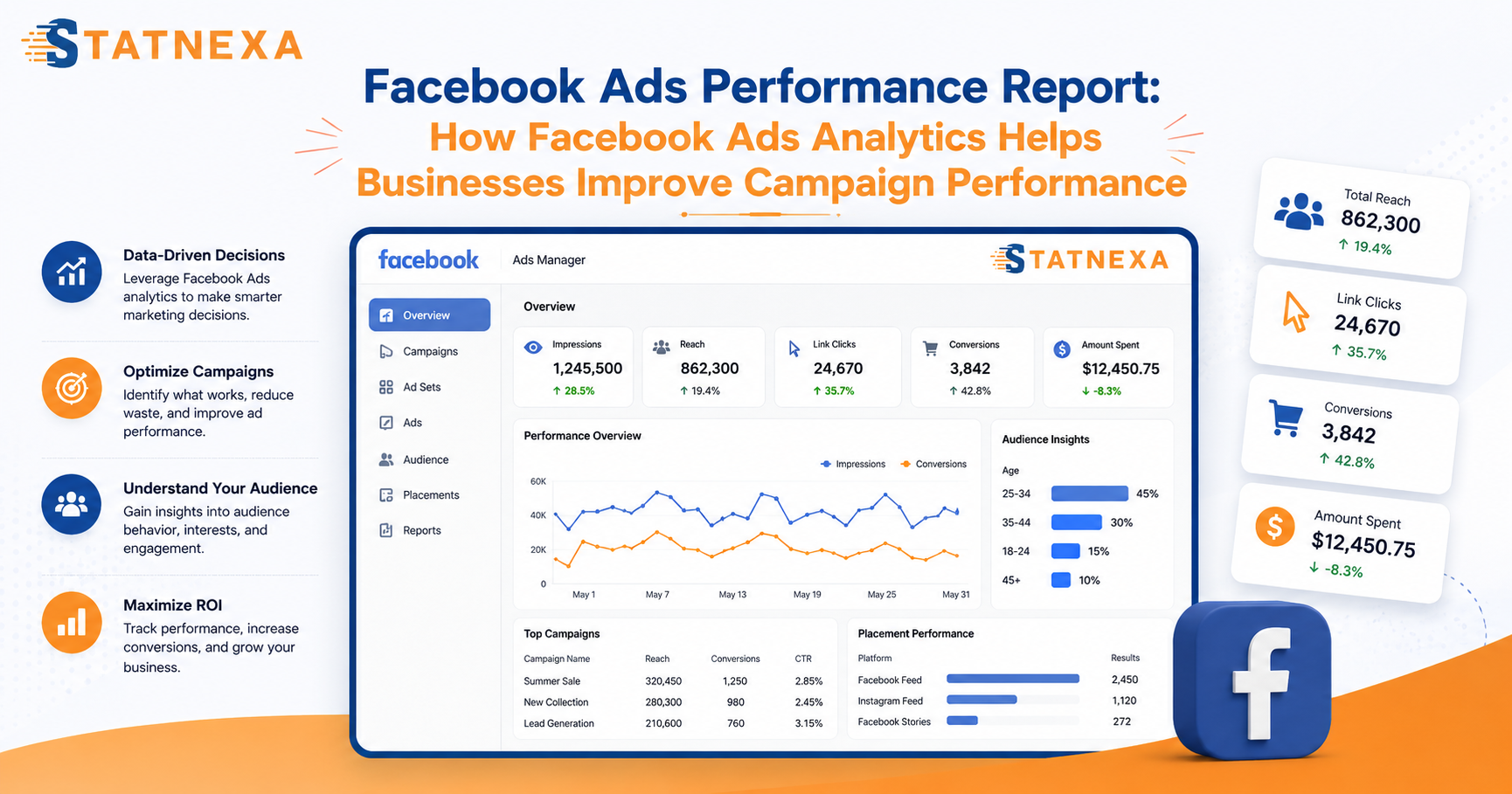
To solve this challenge, Statnexa provides the Facebook Ads Performance Report, a centralized reporting dashboard designed to help businesses monitor advertising performance, campaign engagement, purchases, clicks, spend, and creative performance in one place.
The Facebook Ads Performance Report helps marketers, agencies, ecommerce brands, and performance teams better understand Facebook advertising performance and make smarter campaign decisions.
Why Facebook Ads Reporting Matters for Modern Marketing
Advertising performance depends heavily on data.
Without proper reporting, businesses often make campaign decisions based on assumptions rather than actual performance insights.
For example, a campaign may generate high click volume but poor conversion performance.
Another campaign may receive fewer clicks but significantly higher website purchases.
Without deeper performance visibility, businesses may incorrectly increase budgets for campaigns that generate activity but fail to produce meaningful business outcomes.
This makes Facebook Ads reporting extremely valuable for:
• Ecommerce businesses
• Marketing agencies
• SaaS companies
• Growth marketers
• Performance marketing teams
• Digital advertising professionals
Businesses that track Facebook Ads performance properly can better understand:
• Which campaigns generate purchases
• Which creatives improve engagement
• Which audiences convert best
• How advertising spend affects profitability
• Which campaigns deserve scaling
• Which ads underperform As advertising competition on Facebook continues increasing, businesses need better visibility into campaign performance to improve efficiency and maximize return on ad spend.
How Facebook Ads Analytics Helps Businesses Improve Campaign Performance
Facebook advertising success depends on more than impressions and clicks.
Businesses need deeper insights into audience behavior, conversion performance, ad engagement, and campaign efficiency.
By monitoring Facebook Ads analytics, businesses can identify:
• Which campaigns generate purchases
• Which ads improve CTR
• Which creatives drive engagement
• Which audiences convert more effectively
• Which campaigns waste advertising budget
• Which ads deserve scaling
These insights help businesses make smarter optimization decisions.
Instead of relying on assumptions, marketers can use performance data to improve:
• Audience targeting
• Creative strategy
• Campaign structure
• Budget allocation
• Ad messaging
For example, businesses may discover that one ad set consistently drives stronger purchases despite lower impressions.
Another campaign may generate clicks but poor landing page engagement.
These insights help marketers optimize future campaigns and improve advertising efficiency. The Facebook Ads Performance Report simplifies this process by bringing major Facebook Ads KPIs into one centralized reporting dashboard.
How Facebook Ads Metrics Help Businesses Improve Advertising Performance
Understanding Facebook campaign performance requires more than basic traffic numbers.
Businesses need actionable insights into conversions, engagement, spending efficiency, audience interaction, and creative effectiveness. The Facebook Ads Performance Report includes important Facebook Ads KPIs that help businesses make better advertising decisions.
Website Purchases
Website Purchases are one of the most important Facebook Ads metrics.
Because impressions and clicks alone do not generate business growth.
Purchases do.
Tracking Website Purchases helps businesses understand:
• Which campaigns generate revenue
• Which audiences convert best
• Which creatives influence buying decisions
• Which ads deserve additional budget
Businesses can compare purchase performance across campaigns to identify profitable advertising opportunities.
Instead of optimizing only for engagement, marketers can optimize for business outcomes.
CTR (Link Click-Through Rate)
CTR measures how often users click on advertisements after seeing them.
This metric helps businesses evaluate:
• Ad effectiveness
• Audience targeting quality
• Messaging relevance
• Creative performance
Higher CTR often indicates:
• Better ad creatives
• Stronger targeting
• More compelling messaging
• Better audience alignment
Low CTR may suggest weak ad copy, poor visuals, audience mismatch, or ineffective offers. Businesses can use CTR insights to improve future campaigns and optimize ad performance.
Amount Spent
Advertising spend plays an important role in Facebook campaign performance.
Businesses need to understand whether investment produces measurable outcomes or simply increases visibility without results.
Tracking Amount Spent helps businesses:
• Monitor campaign budgets
• Compare cost versus performance
• Evaluate advertising profitability
• Identify inefficient campaigns
For example, if advertising spend continues increasing while purchases remain flat, campaigns may require optimization.
On the other hand, increasing spend alongside stronger purchase performance often indicates successful scaling.
Understanding spend patterns helps businesses allocate budgets more effectively.
Clicks (All)
Clicks help businesses understand audience interaction and campaign engagement.
This metric measures how frequently users interact with advertisements.
Tracking Clicks helps businesses understand:
• Audience interest
• Traffic generation
• Ad engagement performance
• Creative effectiveness
Higher click volume often indicates stronger audience interest.
However, clicks alone do not guarantee performance success.
Businesses should analyze clicks alongside purchases, landing page views, and conversions.
Impressions
Impressions measure how often advertisements appear to audiences.
Tracking impressions helps businesses:
• Monitor campaign visibility
• Measure audience exposure
• Compare awareness performance
• Analyze campaign reach
Higher impressions often indicate stronger visibility.
However, impressions without engagement or purchases may suggest weak creative performance or audience targeting. This makes impressions more valuable when analyzed together with CTR and conversion metrics.
CPC (All)
Cost Per Click (CPC) helps businesses understand advertising efficiency.
This metric helps marketers evaluate:
• Campaign cost performance
• Budget efficiency
• Audience competitiveness
• Cost optimization opportunities
Lower CPC often signals stronger targeting and better ad performance.
Higher CPC may indicate stronger competition or inefficient campaign targeting.
Businesses can use CPC insights to optimize campaign budgets and improve advertising efficiency.
Landing Page Views
Landing Page Views help businesses understand what happens after ad clicks.
Not every click results in meaningful engagement.
Tracking Landing Page Views helps businesses evaluate:
• Website performance
• Traffic quality
• User experience
• Conversion opportunities
For example, high clicks with weak landing page views may indicate poor website speed or weak page experience.
Businesses can use these insights to improve landing pages and conversion performance.
Post Reactions, Comments, and Shares
Engagement metrics such as reactions, comments, and shares help businesses understand audience interaction quality.
These metrics help marketers measure:
• Content engagement
• Audience sentiment
• Creative effectiveness
• Brand awareness performance
Higher engagement often signals stronger audience interest and more relevant advertising content.
Businesses can identify stronger-performing creatives and improve future advertising strategies.
Page Engagement
Page Engagement measures how users interact with business content.
Tracking Page Engagement helps businesses understand:
• Audience interest levels
• Brand engagement performance
• Content effectiveness
• Community interaction Stronger engagement often contributes to better long-term audience relationships.
Best Performing Campaigns, Ad Sets, and Ads
Not every campaign performs equally.
Some campaigns generate stronger purchases.
Some audiences convert better.
Some creatives consistently outperform others.
The Facebook Ads Performance Report helps businesses identify:
Best Performing Campaigns
Businesses can quickly understand:
• Which campaigns generate stronger results
• Which campaigns deserve more investment
• Which campaigns improve ROI
Best Performing Ad Sets
Ad set performance helps marketers evaluate:
• Audience targeting effectiveness
• High-converting audience groups
• Better segmentation opportunities
Best Performing Ads
Creative quality often determines Facebook advertising success.
Businesses can identify:
• Which ads drive engagement
• Which creatives improve CTR
• Which messaging resonates best
• Which formats improve purchases These insights help businesses scale successful strategies faster.
How Facebook Ads Reporting Helps Marketing Agencies
Marketing agencies often manage multiple advertising campaigns across different clients.
This creates reporting complexity.
Clients want to understand:
• Campaign performance
• Advertising spend efficiency
• Conversion growth
• Which campaigns generate results
However, manually building reports every week becomes time-consuming.
The Facebook Ads Performance Report helps agencies centralize campaign reporting and improve performance visibility inside one dashboard. Instead of spending time exporting reports, agencies can focus on campaign optimization.
Why Businesses Need Facebook Ads Analytics Now
Facebook advertising continues becoming more competitive.
Advertising costs continue increasing.
Creative fatigue happens faster.
Audience attention becomes harder to capture.
Businesses that fail to track performance properly often struggle with:
• Rising advertising costs
• Poor conversion visibility
• Weak audience targeting
• Inefficient spending
• Missed optimization opportunities
Businesses using centralized Facebook analytics gain a major competitive advantage.
They can:
• Improve campaign performance faster
• Optimize audience targeting
• Reduce wasted spend
• Improve purchases and conversions
• Scale successful campaigns faster
As competition continues growing, performance reporting becomes essential for long-term advertising success.
How Statnexa Helps Businesses with Facebook Ads Reporting
Statnexa helps businesses simplify Facebook Ads reporting through ready-to-use analytics dashboards designed for marketers, agencies, ecommerce brands, and performance teams.
The Facebook Ads Performance Report helps businesses:
• Monitor purchases and conversions
• Track CTR and CPC performance
• Analyze campaign spend
• Understand audience engagement
• Identify top-performing campaigns
• Monitor best-performing ad sets and creatives
• Improve advertising efficiency
Instead of manually building fragmented reports, businesses can instantly access centralized Facebook Ads insights with actionable performance data.
As Facebook advertising becomes more competitive, businesses that invest in better analytics will gain a stronger competitive advantage. The Facebook Ads Performance Report helps businesses transform advertising data into smarter decisions, stronger campaign performance, and better business growth.
Frequently Asked Questions About Facebook Ads Analytics
What is Facebook Ads Analytics?
Facebook Ads Analytics is the process of analyzing advertising performance data to understand campaign effectiveness, audience behavior, conversions, and return on ad spend.
Which Facebook Ads metrics are most important?
Key metrics include Website Purchases, CTR, CPC, Amount Spent, Landing Page Views, Impressions, Clicks, and Engagement metrics.
Why is Facebook Ads reporting important?
Reporting helps businesses identify successful campaigns, optimize budgets, improve targeting, and increase advertising ROI.
How can businesses improve Facebook Ads performance?
Businesses can improve performance by tracking analytics, optimizing audience targeting, testing creatives, monitoring conversions, and scaling top-performing campaigns.
How does Statnexa help with Facebook Ads reporting?
Statnexa provides a centralized Facebook Ads Performance Report that helps businesses monitor KPIs, analyze campaign performance, and make data-driven marketing decisions.