
Running a marketing agency is a constant balancing act. On one hand, you want to bring in new retainer clients and grow your revenue. On the other, your team is already working long hours trying to deliver results for the clients you already have.
When you manage three or four accounts, keeping up with keyword research, technical site audits, content briefs, and monthly reports is fairly easy. But try stretching that same workflow to fifteen or twenty clients. Cracks start to show fast. Your account managers spend half their week manually building reporting slides. Your strategists spend days digging through spreadsheets. Quality drops, burn-out creeps in, and your growth hits a hard ceiling.
This operational bottleneck is where traditional processes break down. To scale your agency without doubling your team’s headcount, you need smart leverage.
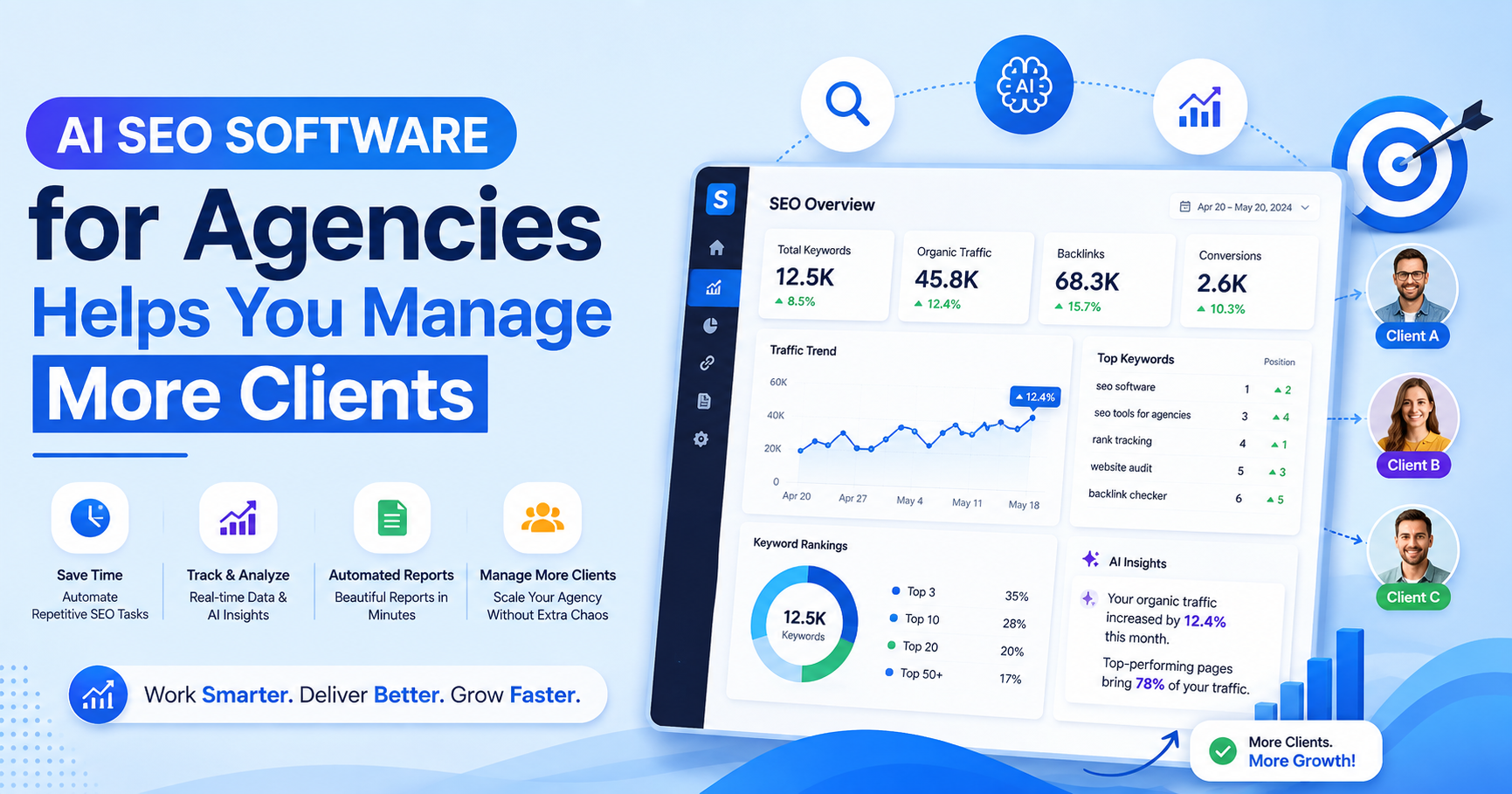
Adopting specialized SEO software for agencies backed by artificial intelligence transforms how teams operate. AI SEO tools do not replace human strategy or creative judgment; instead, they act as an force multiplier that takes heavy, repetitive busywork off your plate so you can handle significantly more accounts with higher margins.
Here is how smart AI software solves the agency capacity crisis and helps you onboard more clients smoothly.
The Real Capacity Trap Holding Agencies Back
Every agency owner knows the feeling: you want to pitch bigger deals, but deep down, you worry about how your team will actually execute the work if the prospect signs.
Why does scaling organic search services feel so heavy? Because organic search relies on dozens of manual, multi-step tasks:
- Crawling sites and organizing technical errors by priority
- Running intent research and mapping keyword opportunities
- Building structured content outlines for copywriters
- Formatting and sending customized, white-label client reports
[ Manual Workflows ]  ──>  [ 5-10 Hours / Client / Month ]  ──>  Capacity Ceiling
[ AI Automation ]     ──>  [ 1-2 Hours / Client / Month ]   ──>  Scalable Growth
When those steps depend entirely on manual labor, every new client adds a direct linear burden to your payroll. Using flexible SEO software for agencies breaks this cycle by compressing tasks that used to take eight hours into thirty minutes of automated processing.
1. Automated Technical Audits That Prioritize What Matters
When onboarding a new client, performing a comprehensive site audit is always the first major hurdle. Traditional crawlers give you endless spreadsheets containing thousands of line items. Your SEO specialists then have to spend hours filtering out minor notices to find the critical issues that are actually blocking rankings.
Modern AI SEO software for agencies uses machine learning models to crawl client sites and interpret the data instantly.
Instead of showing a raw list of broken links or missing meta tags, AI tools:
- Categorize issues by real business impact: They group problems based on how severely they hurt site health and organic traffic.
- Generate step-by-step dev instructions: The software writes clear technical tickets complete with recommended code fixes or CMS instructions.
- Draft client-friendly summaries: AI distills complex technical jargon into plain English summaries you can insert straight into an onboarding presentation.
Instead of spending two full days analyzing a new domain, your strategist gets a prioritized action plan in minutes. That means you can onboard new accounts faster without pulling senior staff away from high-level client comms.
2. Scaling Keyword Research and Content Briefs
Creating high-ranking search content used to require hours of manual intent analysis, SERP scraping, and brief preparation for every single article. If you publish 20 or 30 pieces of content across multiple clients every month, brief creation alone becomes a full-time job.
AI-powered SEO software for agencies revolutionizes this content assembly line.
Raw Keyword List
       │
       ▼
┌─────────────────────────────────────────┐
│ AI Intent & Topic Clustering Engine     │
└─────────────────────────────────────────┘
       │
       ▼
Structured Content Briefs & Outlines
Smart Clustering
Rather than analyzing terms one by one, AI systems take thousands of raw keywords, group them by search intent, and map them to targeted parent pages. This prevents keyword cannibalization across your client roster.
Instant Brief Generation
With a single click, the software analyzes top-ranking competitors for a primary keyword, extracts target headings, calculates ideal word counts, and lists essential semantic entities.
The result? Your content managers hand complete, highly detailed briefs to writers in minutes rather than hours. This speed lets you scale content output dramatically while maintaining strict quality standards.
3. Automated White-Label Reporting That Saves 10+ Hours Per Client
If you ask agency team members what task they dread most each month, almost all of them will give the same answer: Seo tracking.
Extracting numbers from Google Analytics 4, Search Console, rank trackers, and backlink platforms to paste into slide decks is a huge time drain. It wastes valuable talent on data entry.
Old Way:  GA4 + Search Console + Rank Trackers ──> Manual Copy/Paste ──> Slides (8 Hours)
New Way:  Unified Integrations ──> Automated AI Insights ──> Live Dashboard (15 Mins)
By leveraging dedicated SEO software for agencies, reporting transitions from a painful manual chore into a seamless, automated process:
- Unified Dashboards: Connect all client data sources into one white-labeled dashboard featuring your agency’s branding.
- AI Narrative Summaries: Machine learning models analyze month-over-month performance shifts and automatically write clear, executive summaries explaining why traffic went up or down.
- Scheduled Delivery: Set reports to generate and send to clients automatically on the first of every month.
When client reporting takes 15 minutes instead of 8 hours per account, your account management team instantly regains dozens of billable hours every single month.
4. Proactive Site Monitoring and Rank Tracking
Clients expect you to protect their organic visibility around the clock. However, manually checking keyword movements, indexation issues, or accidental canonical tag changes across dozens of websites is practically impossible.
Advanced Seo tracking acts as an automated monitoring system:
| Feature | What It Does Automatically | Agency Benefit |
| Real-Time Rank Tracking | Tracks local and global rank shifts daily | Spot performance trends early before the client notices |
| Anomaly Detection | Flags sudden traffic drops or indexation errors instantly | Fix bugs immediately instead of finding out weeks later |
| Competitor Alerting | Monitors competitor content updates and link wins | Give clients proactive strategic advice during reviews |
This proactive protection keeps accounts healthy and improves retention rate. Keeping clients longer means every new account you add contributes directly to net revenue growth rather than replacing lost business.
How to Integrate AI SEO Software Without Losing Quality
While AI offers incredible efficiency, running an agency on “autopilot” without human oversight is a recipe for generic output and lost trust. The most successful agencies use AI to power production tasks while relying on senior humans for strategic direction and relationship management.
Here is how to strike the perfect balance:
- Keep Humans in the Strategy Loop: Let AI process data and highlight patterns, but ensure an experienced SEO strategist reviews and approves all final roadmaps.
- Refine AI-Generated Content: Use AI to build briefs and first drafts, but always have native human editors polish tone, verify facts, and add personal brand insights.
- Focus on Client Business Goals: Tailor automated reports to highlight metrics clients care about-leads, sales, and bottom-line revenue-rather than just vanity search metrics.
Conclusion:
Growing a digital marketing agency does not mean your staff needs to work late nights or drown in endless spreadsheets.
Equipping your team with modern SEO software for agencies eliminates repetitive operational tasks, speeds up content production, and automates client reporting. You build a leaner, faster operation capable of taking on double the client load-all while keeping service quality high and team stress low.