
Search engine optimization has become one of the most valuable long-term growth strategies for businesses looking to improve visibility, generate qualified traffic, and increase conversions through organic search. Whether it is an ecommerce store competing for product keywords, a SaaS company targeting high-intent search terms, or a local business trying to dominate regional results, SEO performance directly impacts digital growth.
However, SEO success is no longer as simple as publishing content and waiting for rankings to improve.
Search competition continues increasing across every industry. Google’s algorithm evolves constantly. User behavior changes. Search intent becomes more competitive. Businesses that fail to monitor performance often struggle to understand what is actually helping rankings improve and what is slowing growth.
This is why rank tracking has become an essential part of modern SEO.
Businesses need visibility into how keywords perform, how content contributes to search traffic, how users interact with landing pages, and whether SEO efforts generate meaningful business outcomes.
Without proper reporting, SEO quickly becomes guesswork.
A website may generate thousands of impressions but very few clicks.
A page may rank well for certain keywords but fail to keep visitors engaged.
Another piece of content may attract less traffic yet drive significantly stronger conversions.
Without centralized SEO reporting, these insights often remain hidden.
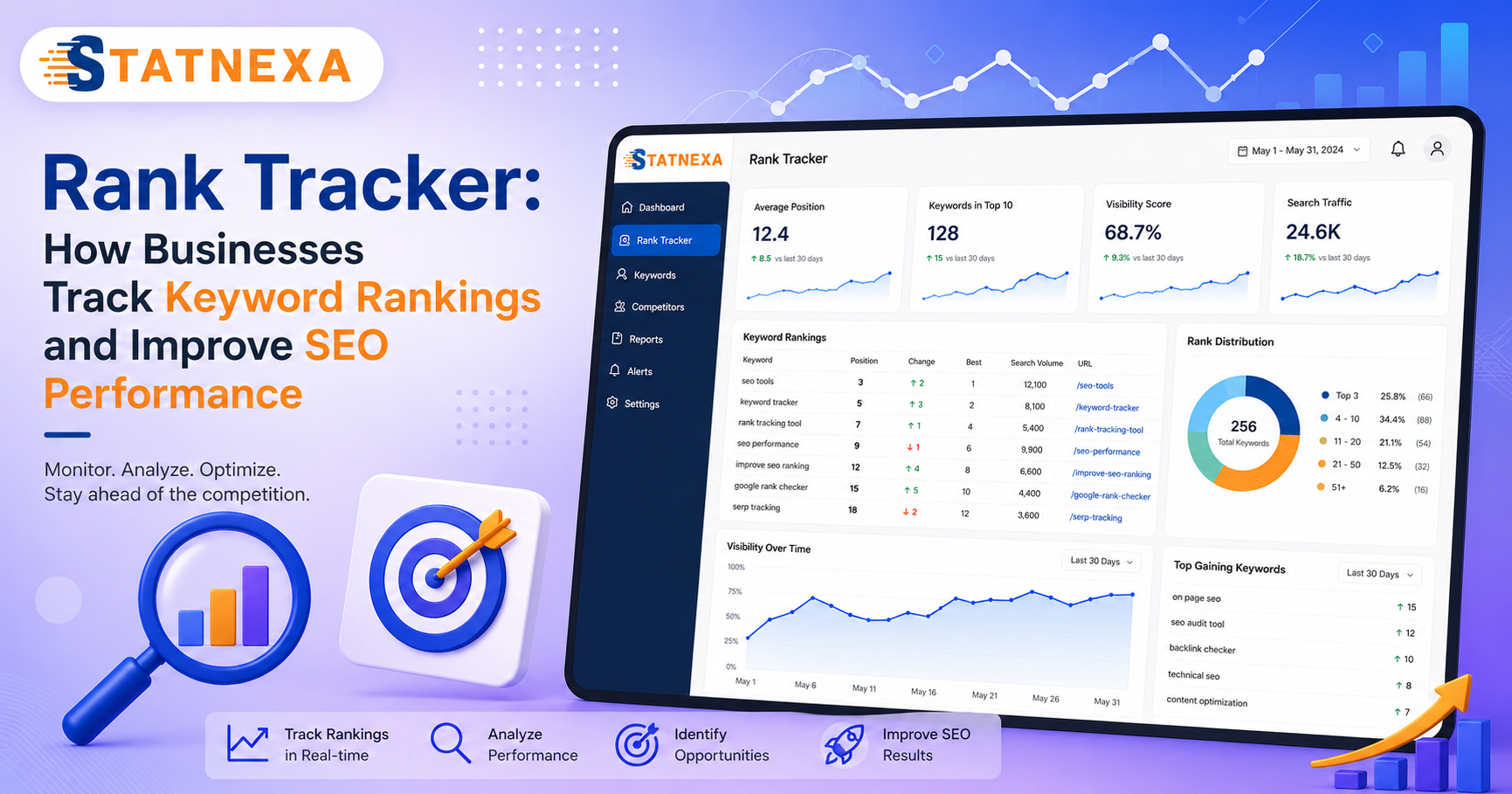
To solve this challenge, Statnexa provides the Rank Tracker, a centralized SEO dashboard designed to help businesses monitor keyword rankings, content performance, search visibility, user engagement, and conversion-focused SEO metrics in one place.
Instead of switching between multiple reporting tools, businesses can access a complete picture of SEO performance inside a single dashboard.
Why SEO Reporting Matters More Than Ever
Search visibility has become one of the strongest drivers of online growth.
Consumers increasingly rely on Google to research products, compare services, solve problems, and discover businesses. This means ranking well for relevant search terms often determines whether businesses attract traffic or lose opportunities to competitors.
However, SEO performance is not always easy to measure.
Many businesses still focus only on rankings.
While rankings matter, they tell only part of the story.
For example, a keyword may move into the top five search positions but generate weak traffic because click-through rates remain low.
Similarly, a content page may receive strong impressions but fail to engage visitors after they arrive.
This creates a common problem:
Businesses invest time and budget into SEO without clearly understanding performance.
Without proper reporting, marketers struggle to answer important questions such as:
• Which keywords are improving visibility?
• Which pages generate organic traffic?
• Which content performs best?
• Which search terms drive engagement?
• How does SEO contribute to conversions?
• Which opportunities deserve optimization?
Without clear answers, businesses often make SEO decisions based on assumptions rather than actual search performance data.
This makes centralized SEO reporting extremely valuable for:
• Ecommerce businesses
• SaaS companies
• Agencies
• Content publishers
• SEO professionals
• Growth marketing teams
Businesses that monitor SEO properly gain stronger visibility into what drives results and where improvements are needed.
Why Keyword Rankings Alone Are Not Enough
One of the biggest misconceptions in SEO is that rankings alone determine success.
Ranking higher certainly helps.
But ranking higher does not automatically guarantee growth.
Imagine a business ranking in position three for a high-volume keyword.
At first glance, performance looks strong.
However, deeper analysis reveals:
• Click-through rates remain low
• Users leave quickly
• Engagement is weak
• Conversion performance stays poor
Meanwhile, another page ranking slightly lower generates stronger engagement and better conversion performance as using white label rank tracker
This happens because SEO success depends on more than rankings.
Businesses also need to understand:
• Search visibility
• User behavior
• Content effectiveness
• Click performance
• Engagement quality
• Conversion impact
SEO becomes significantly more valuable when businesses combine ranking data with engagement and conversion insights.
This is where a centralized Rank Tracker becomes essential for any agency.
Instead of focusing only on rankings, businesses can understand how SEO contributes to overall growth.
The question changes from:
“Did rankings improve?”
To:
“Is SEO driving meaningful business results?”
That shift completely changes how businesses approach optimization.
How Rank Tracking Helps Businesses Improve SEO Performance
Successful SEO depends on identifying opportunities quickly.
Businesses that monitor rankings and organic search behavior consistently can react faster to performance changes.
Rank tracking helps businesses identify:
• Which keywords improve visibility
• Which pages lose rankings
• Which content drives traffic
• Which topics attract users
• Which opportunities deserve investment
For example, a blog article may consistently improve rankings while generating strong engagement and organic traffic.
This insight signals an opportunity to expand content around similar topics.
At the same time, another page may receive impressions but weak click-through rates.
This may suggest problems with search snippets, metadata, or search intent alignment.
These insights allow businesses to optimize based on actual performance rather than assumptions.
Instead of guessing, marketers can improve:
• Content strategies
• Keyword targeting
• Page optimization
• Search visibility
• User engagement
The Rank Tracker simplifies this process by combining essential SEO performance indicators inside one reporting environment.
Which SEO Metrics Actually Matter?
SEO reporting often becomes overwhelming because businesses monitor too many disconnected metrics.
The key is understanding which metrics actually influence performance.
The Rank Tracker focuses on meaningful SEO KPIs that help businesses improve visibility and growth.
Google Rankings
Keyword rankings remain one of the strongest indicators of search visibility.
Tracking Google Rankings helps businesses understand which keywords move higher, which pages improve visibility, and which rankings decline over time.
However, rankings alone should never be viewed in isolation.
Strong rankings become significantly more valuable when analyzed alongside clicks, impressions, engagement, and conversions.
A keyword ranking on page one but generating weak engagement may still require optimization.
This is why businesses need deeper visibility into performance.
Impressions and Search Visibility
Impressions help businesses understand how frequently pages appear in search results.
Growing impressions often indicate stronger search visibility and expanding keyword reach.
However, visibility alone does not guarantee growth.
A website may appear thousands of times in Google Search but fail to attract meaningful traffic if users are not clicking.
This is why impressions become much more valuable when analyzed alongside CTR and search position.
Businesses can better understand whether growing visibility translates into actual opportunity.
Google Clicks and Traffic Performance
Clicks reveal whether users actually visit websites after discovering pages in search results.
Tracking clicks helps businesses evaluate:
• Organic traffic growth
• Keyword relevance
• Search intent alignment
• Content discoverability
Pages generating strong clicks often signal better alignment between search intent and content relevance.
Businesses can identify which pages deserve further optimization and which keywords contribute most to growth.
Average CTR
Click-through rate helps businesses understand how attractive search results appear to users.
Even strong rankings may underperform if titles and descriptions fail to encourage clicks.
A weak CTR may suggest:
• Poor title optimization
• Weak metadata
• Search intent mismatch
• Low content relevance
Improving click-through rates often leads to meaningful traffic improvements without needing higher rankings.
For many businesses, CTR optimization becomes one of the fastest SEO wins.
Keyword Visibility & Market Tracking
SEO performance is highly competitive.
Businesses need to understand overall search visibility, not just isolated keyword rankings.
The Rank Tracker includes keyword visibility and market tracking insights that help businesses evaluate broader SEO performance.
This helps marketers understand:
• Which keyword groups improve visibility
• How competitive positioning changes
• Which markets offer stronger opportunities
This level of visibility improves long-term SEO planning.
Why Combining Google Search Console and Google Analytics 4 Matters
One of the biggest SEO reporting problems is fragmented data.
Google Search Console explains:
How users discover websites.
Google Analytics 4 explains:
What users do after arriving.
Separately, both tools provide useful insights.
Together, they become significantly more powerful.
Google Search Console helps businesses monitor:
• Impressions
• Rankings
• Clicks
• CTR
• Search visibility
Google Analytics 4 helps businesses understand:
• Content performance
• User engagement
• Website behavior
• Conversion performance
• Traffic quality
Together, businesses can move beyond rankings and understand how SEO contributes to meaningful business growth.
How Content Performance Affects SEO Success
Content remains one of the strongest ranking factors in organic search.
However, publishing more content does not always guarantee results.
Businesses need to understand:
• Which pages attract users
• Which topics generate engagement
• Which content improves conversions
• Which pages lose visibility
The Rank Tracker includes Content Performance (by Views) and Content Effectiveness & Engagement metrics to help businesses understand how users interact with SEO content.
This helps marketers identify high-performing pages and optimize weaker content more effectively.
Instead of publishing blindly, businesses can invest in strategies supported by performance data.
Why Businesses Need Rank Tracking Now
Search competition continues increasing.
Businesses that fail to monitor SEO performance properly often struggle with:
• Declining rankings
• Weak organic traffic
• Poor search visibility
• Missed keyword opportunities
• Slower content growth
Businesses using centralized SEO analytics gain a significant competitive advantage.
They can:
• Improve rankings faster
• Optimize content strategically
• Identify opportunities earlier
• Improve engagement performance
• Increase organic visibility
SEO growth depends heavily on speed and visibility.
Businesses that understand performance faster often improve results faster.
How Statnexa Helps Businesses Improve SEO Reporting
Statnexa helps businesses simplify SEO reporting through centralized dashboards designed for marketers, agencies, SaaS companies, ecommerce brands, and SEO professionals. See how to connect multi platform channels in one dashboard.
The Rank Tracker helps businesses:
• Monitor keyword rankings
• Track search visibility
• Analyze content performance
• Measure engagement quality
• Understand clicks and impressions
• Improve SEO strategies
• Track conversion-focused performance
Instead of manually collecting fragmented SEO data, businesses can instantly access centralized insights inside one dashboard.
As search competition continues growing, businesses that invest in better SEO reporting will make smarter optimization decisions and achieve stronger long-term growth. The Rank Tracker helps businesses transform SEO performance data into better rankings, stronger visibility, and more meaningful business outcomes.