
Modern marketing is no longer only about generating traffic.
Businesses today invest heavily in SEO, paid advertising, email campaigns, lead nurturing, CRM management, and sales automation to attract prospects and convert them into customers.
However, generating leads alone does not guarantee business growth.
The real challenge begins after leads enter the funnel.
Businesses need to understand:
• How many leads become customers
• Which contacts qualify as MQLs and SQLs
• How email campaigns influence engagement
• Which marketing efforts improve conversions
• Why leads drop from the funnel
• Which channels contribute to customer growth
This is where HubSpot reporting becomes extremely important.
HubSpot has become one of the most widely used platforms for CRM management, inbound marketing, email automation, and sales pipeline tracking. Businesses use HubSpot to manage contacts, nurture leads, automate campaigns, and monitor customer journeys.
However, while HubSpot provides powerful marketing and sales capabilities, many businesses struggle to clearly understand performance.
A business may generate thousands of contacts but very few qualified leads.
Email campaigns may produce strong open rates but weak click-through performance.
Marketing teams may generate MQLs, yet sales struggle to convert SQLs into paying customers.
Without centralized reporting, these insights often remain hidden.
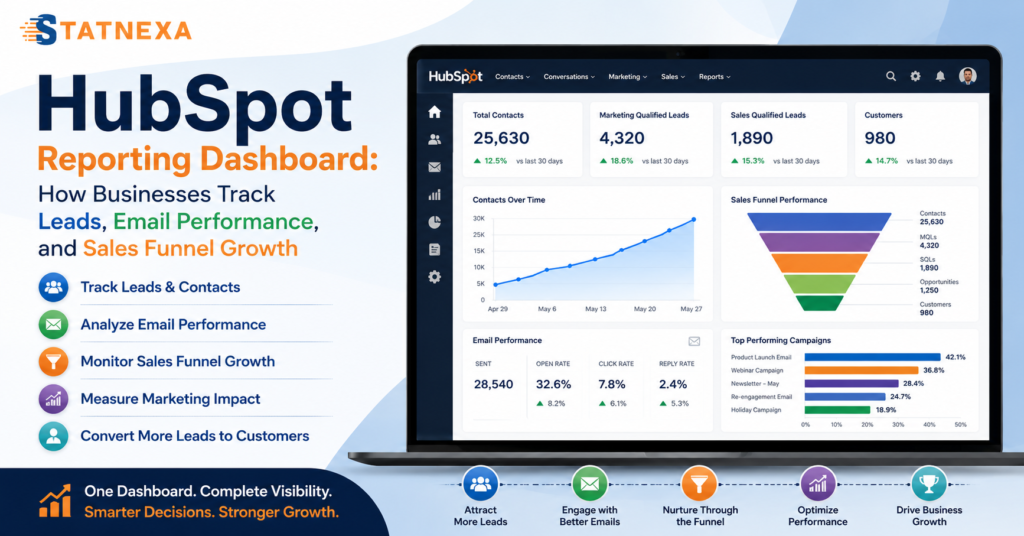
To solve this challenge, Statnexa provides the HubSpot Reporting Dashboard, a centralized reporting solution designed to help businesses monitor contacts, funnel performance, marketing-qualified leads, sales-qualified leads, email marketing performance, and customer growth inside one reporting environment.
Instead of switching between fragmented CRM reports, businesses can access meaningful sales and marketing insights through one centralized dashboard.
Why HubSpot Reporting Matters More Than Ever
Marketing and sales have become increasingly data-driven.
Businesses now rely on multiple channels to attract leads including:
• SEO
• Paid advertising
• Email marketing
• Content marketing
• Social media
• Referral traffic
However, attracting leads is only part of the process.
The bigger question becomes:
What happens after a lead enters the funnel?
Without proper reporting, marketers and sales teams often struggle to answer important questions such as:
• How many contacts become customers?
• Which leads qualify for sales outreach?
• Why are conversions slowing down?
• Which email campaigns improve engagement?
• Which campaigns generate better lead quality?
• Where do prospects drop in the funnel?
Without clear answers, businesses often make decisions based on assumptions rather than actual funnel performance.
This makes HubSpot reporting essential for:
• SaaS companies
• B2B organizations
• Agencies
• Lead generation businesses
• Ecommerce brands
• Service businesses
• Growth marketing teams
Businesses that monitor HubSpot performance properly gain stronger visibility into lead generation, nurturing, and conversion performance.
Why Total Contacts Alone Do Not Tell the Full Story
One of the biggest mistakes businesses make is focusing only on lead volume.
Contacts matter.
But contacts alone do not define growth.
For example:
A business may generate thousands of contacts every month.
At first glance, performance appears strong.
However, deeper analysis may reveal:
• MQL growth remains weak
• SQL conversions decline
• Email engagement drops
• Customer acquisition slows down
Meanwhile, another business with fewer contacts may consistently generate higher-quality leads and stronger conversion performance.
This happens because business growth depends on more than lead volume.
Businesses also need visibility into:
• Lead quality
• Funnel performance
• Customer conversion
• Email engagement
• Sales readiness
• Marketing effectiveness
Instead of asking:
“How many contacts did we generate?”
Businesses should ask:
“Are our contacts becoming customers?”
That shift changes marketing strategy completely.
How HubSpot Reporting Helps Businesses Improve Funnel Performance
Successful growth depends on understanding what happens throughout the customer journey.
Businesses that monitor HubSpot performance consistently can identify bottlenecks faster and improve conversions.
HubSpot reporting helps businesses understand:
• Which campaigns generate qualified leads
• Which contacts become customers
• Where prospects drop off
• Which email campaigns improve engagement
• Which leads qualify for sales outreach
• Which funnel stages need optimization
These insights help businesses improve:
• Lead nurturing
• Sales alignment
• Email marketing performance
• Customer acquisition
• Funnel optimization
For example:
A business may generate strong contact growth but weak SQL performance.
This insight may signal poor lead qualification.
Similarly, email campaigns may show high open rates but low click-through rates, indicating stronger subject lines but weaker content engagement.
These insights help marketers optimize campaigns using real performance data instead of assumptions.
Which HubSpot Metrics Actually Matter?
CRM reporting often becomes overwhelming when businesses focus on too many disconnected metrics.
The key is understanding which KPIs actually contribute to growth and customer acquisition.
The HubSpot Reporting Dashboard focuses on meaningful performance indicators that help businesses improve marketing and sales outcomes.
Total Contacts and Customer Growth
Lead generation remains an important indicator of marketing performance.
Tracking Total Contacts helps businesses understand:
• Audience growth
• Lead generation trends
• Marketing reach
• Funnel expansion
However, contact growth becomes significantly more valuable when analyzed alongside customer conversion.
Because high contact volume without meaningful conversions often signals weak lead quality.
Tracking Customers from Contacts helps businesses understand how effectively contacts move through the funnel and contribute to growth.
MQL and SQL Performance
Not every lead is ready for sales.
Tracking Marketing Qualified Leads (MQLs) helps businesses understand:
• Lead quality
• Marketing effectiveness
• Prospect readiness
Meanwhile, SQL from Contacts helps sales teams evaluate:
• Sales readiness
• High-intent leads
• Conversion opportunities
Businesses can better align marketing and sales efforts by understanding lead quality across funnel stages.
Contact Funnel Overview
The customer journey rarely happens instantly.
Tracking the Contact Funnel Overview helps businesses understand:
• Where leads drop off
• Funnel bottlenecks
• Conversion trends
• Customer acquisition performance
This visibility helps marketers and sales teams optimize weak stages of the funnel more effectively.
Email Marketing Performance
Email remains one of the highest ROI marketing channels.
However, successful email marketing depends on engagement quality.
Tracking Email Marketing Performance helps businesses understand:
• Campaign effectiveness
• Subscriber engagement
• Email interaction quality
• Customer communication performance
Businesses can identify stronger-performing campaigns and improve weaker ones.
Email Open Rate and Click-Through Rate
Open rate helps businesses understand whether email subject lines attract attention.
However, opens alone do not define campaign success.
Tracking Email Click-Through Rate helps businesses understand:
• Content effectiveness
• Audience engagement
• Offer relevance
• Customer interest
Higher click-through rates often signal stronger content alignment and more valuable messaging.
Email Bounce Rate and Unsubscribers
Email quality matters.
Tracking Email Bounce Rate helps businesses identify:
• Deliverability issues
• List quality problems
• Campaign performance risks
Meanwhile, Email Unsubscribers help marketers understand:
• Content fatigue
• Messaging problems
• Audience dissatisfaction
These insights help businesses improve long-term email marketing performance.
Performance Email
Not every email campaign performs equally.
Tracking Performance Email helps businesses understand:
• Which campaigns drive engagement
• Which emails improve clicks
• Which campaigns influence conversions
Businesses can replicate stronger-performing email strategies and optimize future campaigns accordingly.
Why Businesses Need HubSpot Reporting Now
Customer acquisition has become increasingly competitive.
Businesses that fail to monitor marketing and sales performance properly often struggle with:
• Weak lead quality
• Funnel inefficiencies
• Poor email engagement
• Slow customer growth
• Missed optimization opportunities
Businesses using centralized HubSpot reporting gain a major competitive advantage.
They can:
• Improve lead quality faster
• Align sales and marketing teams
• Optimize funnel performance
• Improve email engagement
• Increase customer conversions
Businesses that understand funnel performance faster often grow faster.
How Statnexa Helps Businesses Improve HubSpot Reporting
Statnexa helps businesses simplify CRM and marketing analytics through centralized dashboards designed for SaaS companies, agencies, B2B organizations, growth marketers, and lead-generation businesses.
The HubSpot Reporting Dashboard helps businesses:
• Monitor contacts and customer growth
• Track MQL and SQL performance
• Analyze funnel performance
• Measure email engagement
• Understand conversion opportunities
• Improve sales and marketing alignment
Instead of manually collecting fragmented CRM reports, businesses can instantly access centralized insights through one dashboard. The HubSpot Reporting Dashboard helps businesses transform CRM and marketing data into smarter decisions, stronger lead nurturing, and sustainable business growth