
Sales teams generate thousands of leads, opportunities, and customer interactions every month.
However, generating more leads does not automatically lead to higher revenue.
The real challenge lies in understanding how prospects move through the sales pipeline, which campaigns generate qualified leads, why opportunities are won or lost, and where revenue opportunities are being missed.
This is where Salesforce reporting becomes essential.
Salesforce has become one of the world’s leading CRM platforms, helping businesses manage customer relationships, sales pipelines, marketing campaigns, and revenue forecasting. Companies use Salesforce to capture leads, manage opportunities, track customer interactions, and support sales teams throughout the buying journey.
However, while Salesforce stores enormous amounts of business data, many organizations struggle to turn that data into actionable insights.
A business may generate thousands of leads every month but convert only a small percentage into customers.
Sales teams may close deals, yet management struggles to understand which industries perform best, which campaigns produce the highest ROI, or why opportunities are being lost.
Marketing may generate qualified leads, but sales teams may still struggle to convert them into revenue.
Without centralized reporting, these insights often remain hidden.
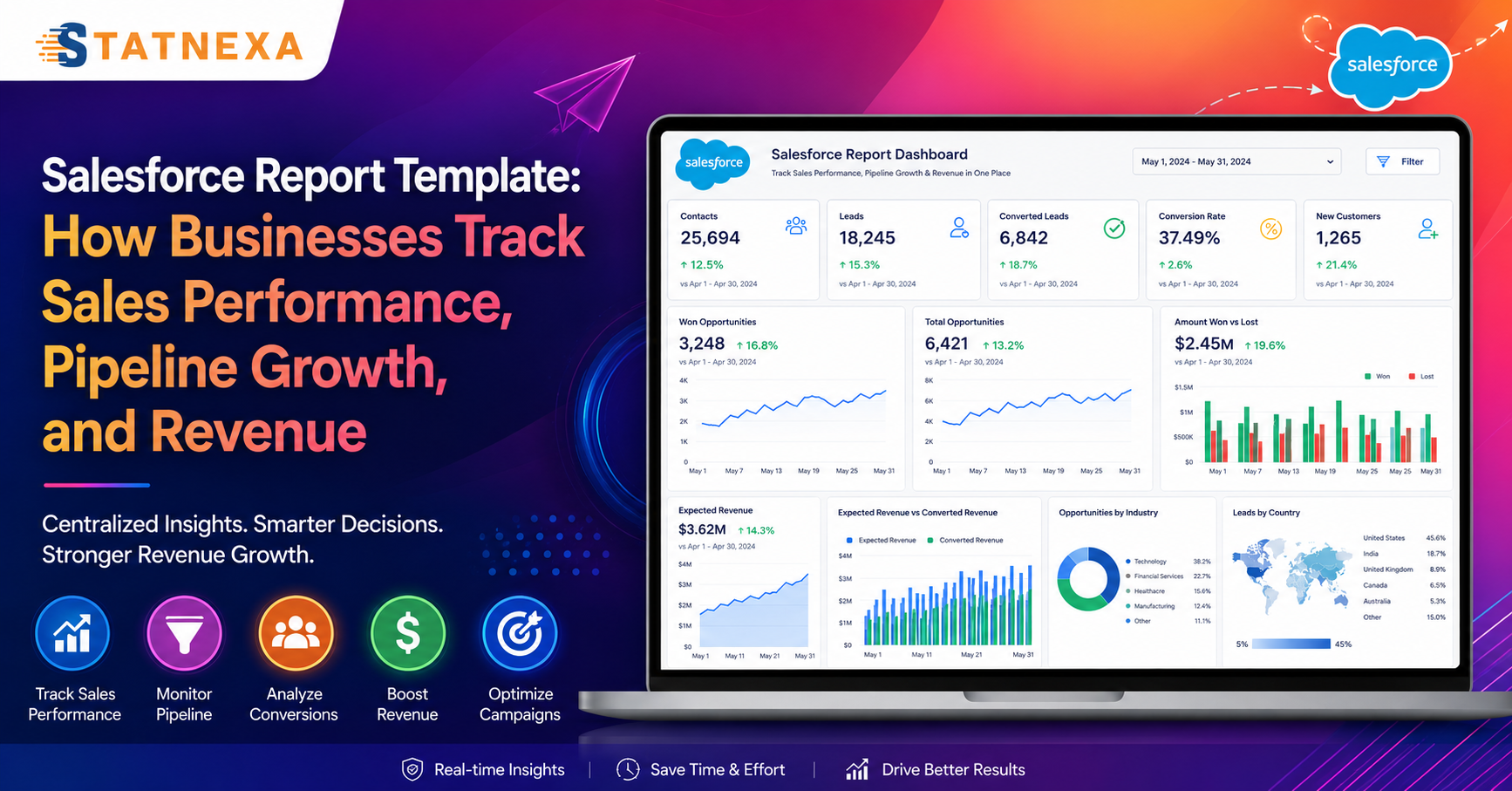
To solve this challenge, Statnexa provides the Salesforce Report Template, a centralized reporting dashboard designed to help businesses monitor leads, opportunities, conversion rates, campaign performance, revenue, and sales pipeline health inside one reporting environment.
Instead of switching between multiple Salesforce reports, spreadsheets, and dashboards, businesses can access meaningful sales insights through one centralized dashboard.
Why Salesforce Reporting Matters More Than Ever
Modern sales has become increasingly data-driven.
Today’s businesses generate leads from multiple channels including:
• Google Ads
• SEO
• Email marketing
• Social media
• Events and webinars
• Referral programs
However, generating leads is only the beginning.
The bigger question becomes:
Which leads actually become customers?
Without proper reporting, sales managers and marketing teams often struggle to answer critical questions such as:
• Which campaigns generate qualified leads?
• Which industries convert best?
• Why are opportunities being lost?
• How accurate are revenue forecasts?
• Which sales representatives close the most deals?
• Which marketing investments generate the highest return?
Without clear answers, businesses often invest more time and money into activities that produce little business value.
This makes Salesforce reporting extremely valuable for:
• SaaS companies
• B2B organizations
• Enterprise businesses
• Sales teams
• Marketing agencies
• Professional service companies
• Revenue operations teams
Businesses that monitor Salesforce performance properly gain stronger visibility into customer acquisition, pipeline health, and revenue growth.
Why Lead Volume Alone Does Not Tell the Full Story
One of the biggest mistakes businesses make is measuring success only by the number of leads generated.
Leads matter.
But lead volume alone does not determine business growth.
For example:
A company may generate thousands of new leads every month.
At first glance, marketing appears successful.
However, deeper analysis may reveal:
• Conversion rates remain low
• Opportunities are declining
• Revenue growth has slowed
• Customer acquisition costs continue increasing
Meanwhile, another business may generate fewer leads but consistently close more opportunities and produce significantly higher revenue.
This happens because business growth depends on lead quality, not just lead quantity.
Businesses also need visibility into:
• Lead qualification
• Opportunity creation
• Customer conversion
• Revenue performance
• Sales pipeline health
• Campaign effectiveness
Instead of asking:
“How many leads did we generate?”
Businesses should ask:
“How many leads became paying customers?”
That shift changes both marketing and sales strategy.
How Salesforce Reporting Helps Businesses Improve Sales Performance
Successful sales organizations rely on data—not assumptions.
Businesses that monitor Salesforce performance consistently can identify bottlenecks earlier, improve forecasting accuracy, and increase revenue opportunities.
Salesforce reporting helps businesses understand:
• Which campaigns generate qualified leads
• Which industries convert best
• Which opportunities are most likely to close
• Which deals are being lost
• Which marketing investments drive revenue
• Which sales activities deserve more focus
These insights help businesses improve:
• Sales forecasting
• Pipeline management
• Lead qualification
• Revenue planning
• Campaign optimization
For example:
A company may discover that leads generated from webinars convert twice as often as leads generated through paid advertising.
Another report may reveal that one industry consistently delivers higher-value opportunities with shorter sales cycles.
These insights allow businesses to focus resources where they produce the greatest return.
The Salesforce Report Template simplifies this process by bringing together essential sales, marketing, and revenue KPIs into one reporting dashboard.
Which Salesforce Metrics Actually Matter?
CRM reporting often becomes overwhelming because businesses collect hundreds of different metrics.
The key is understanding which KPIs actually influence revenue growth.
The Salesforce Report Template focuses on meaningful business metrics that help organizations make better sales and marketing decisions.
Contacts and Lead Conversion
Growing the contact database is important.
However, businesses must understand whether those contacts actually become customers.
Tracking Contacts, Leads vs Converted Leads, and Conversion Rate helps businesses understand:
• Lead quality
• Sales effectiveness
• Marketing performance
• Customer acquisition trends
Businesses can quickly identify where prospects drop out of the sales funnel and where improvements are needed.
Opportunities and Pipeline Health
Healthy pipelines create predictable revenue.
Tracking Won Opportunities, Total Opportunities, and Amount Won vs Lost helps businesses understand:
• Pipeline strength
• Sales performance
• Closing efficiency
• Revenue opportunities
Instead of simply counting deals, businesses can evaluate the overall health of their sales pipeline.
Revenue Performance
Revenue forecasting becomes more reliable when businesses compare expectations against actual performance.
Tracking Expected Revenue, Expected Revenue vs Converted Revenue, and Amount helps businesses evaluate:
• Forecast accuracy
• Revenue growth
• Sales performance
• Business profitability
This visibility helps management make better financial and operational decisions.
New Customers
Revenue growth depends on consistently acquiring new customers.
Tracking New Customers helps businesses understand:
• Customer acquisition performance
• Sales growth
• Business expansion
• Market success
Rather than measuring only lead generation, businesses can focus on actual customer growth.
Opportunities by Industry
Not every market performs equally.
Tracking Opportunities by Industry helps businesses identify:
• High-performing industries
• Strong revenue opportunities
• Market demand
• Sales priorities
Businesses can allocate sales resources toward industries that consistently generate better results.
Leads by Country
Geographic performance plays a major role in business growth.
Tracking Leads by Country helps businesses understand:
• Regional demand
• Market expansion opportunities
• Geographic sales performance
• International growth potential
This insight supports smarter territory planning and regional sales strategies.
Campaign Performance
Marketing campaigns should ultimately support revenue growth.
Tracking:
• Campaigns
• Campaign Sent
• Campaign Performance by Name
• Actual Cost vs Budget Cost
helps businesses understand:
• Campaign effectiveness
• Marketing ROI
• Budget efficiency
• Revenue contribution
Instead of evaluating campaigns by impressions or clicks alone, businesses can understand how marketing influences actual sales outcomes.
Why Businesses Need Salesforce Reporting Now
Sales cycles continue becoming more competitive.
Businesses that fail to monitor sales performance properly often struggle with:
• Weak pipeline visibility
• Poor forecasting accuracy
• Low lead conversion
• Inefficient marketing spend
• Missed revenue opportunities
Businesses using centralized Salesforce reporting gain a significant competitive advantage.
They can:
• Improve lead qualification
• Strengthen pipeline management
• Increase sales efficiency
• Improve forecasting accuracy
• Grow revenue more predictably
Businesses that understand pipeline performance faster often outperform competitors.
How Statnexa Helps Businesses Improve Salesforce Reporting
Statnexa helps businesses simplify Salesforce analytics through centralized dashboards designed for sales leaders, revenue teams, marketers, agencies, SaaS companies, and enterprise organizations.
The Salesforce Report Template helps businesses:
• Monitor leads and customer growth
• Track opportunity performance
• Analyze conversion rates
• Measure campaign effectiveness
• Monitor revenue forecasts
• Improve sales pipeline visibility
Instead of manually combining Salesforce reports with spreadsheets and CRM exports, businesses can instantly access centralized insights through one reporting dashboard. The Salesforce Report Template helps businesses transform CRM data into smarter sales decisions, stronger pipeline management, and predictable long-term revenue growth.