
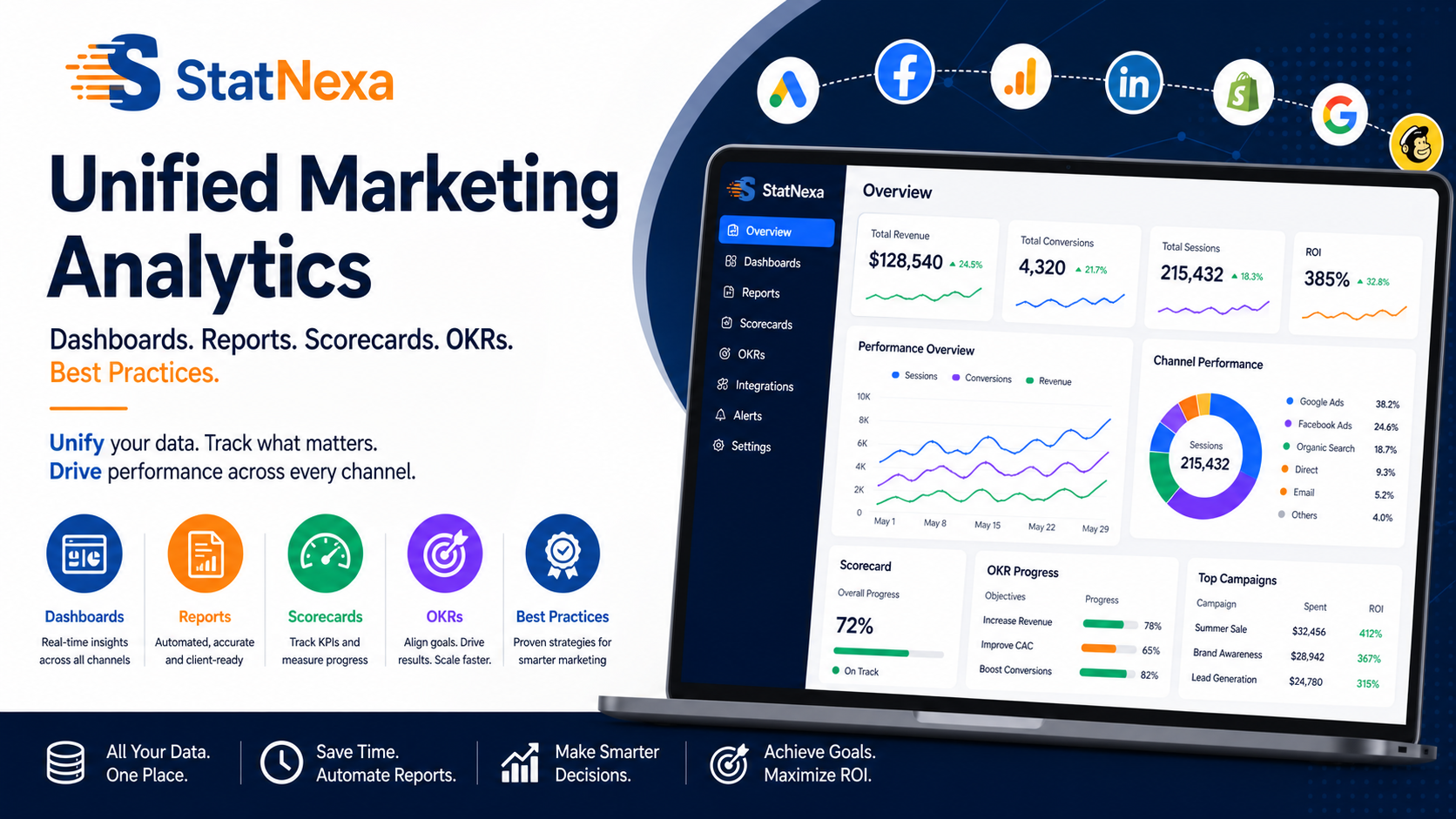
Marketing has evolved dramatically over the last few years. Today, businesses are running campaigns across multiple channels including Google Ads, Facebook Ads, LinkedIn, SEO platforms, email marketing systems, CRM tools, ecommerce platforms, and analytics software. While this creates more opportunities for growth, it also creates a major challenge: marketing data fragmentation.
Most organizations still manage data across disconnected dashboards and spreadsheets. Teams spend hours manually exporting reports, combining metrics, and trying to understand which campaigns are actually driving business growth. This approach slows down decision-making, reduces visibility, and makes scaling marketing operations much harder.
This is where Unified Marketing Analytics Platform becomes essential.
Unified marketing analytics helps businesses centralize all marketing data into one platform, enabling teams to monitor performance, automate reporting, track KPIs, measure OKRs, and make smarter decisions in real time.
Platforms like are StatNexa helping agencies and marketing teams move from disconnected reporting systems to a unified analytics environment that combines dashboards, scorecards, reports, and business intelligence into one centralized platform.
What is Unified Marketing Analytics?
Unified marketing analytics is the process of consolidating marketing data from multiple channels and platforms into a single analytics system.
Instead of reviewing data separately inside:
- Google Analytics
- Meta Ads
- LinkedIn Ads
- Search Console
- HubSpot
- Shopify
- CRM systems
…teams can monitor everything through one centralized dashboard.
The purpose of unified analytics is to create a single source of truth for marketing performance.
This unified view allows businesses to:
- track campaign performance in real time
- compare channels side-by-side
- identify high-performing campaigns
- automate reporting
- improve ROI measurement
- make faster marketing decisions
Unified analytics eliminates the confusion caused by fragmented reporting systems and helps organizations focus on insights rather than spreadsheets.
Why Unified Marketing Analytics Matters
Modern marketing teams manage more data than ever before. Every platform has its own metrics, attribution model, and reporting structure.
Without unified analytics, organizations face several problems:
1. Data Silos
Each platform shows only a small part of the customer journey.
For example:
- SEO tools track rankings
- Google Ads tracks paid traffic
- CRM systems track leads
- social media tools track engagement
But none of these systems independently provide a complete picture of marketing performance.
2. Manual Reporting
Many agencies and marketing teams still spend hours:
- exporting CSV files
- updating spreadsheets
- creating PowerPoint reports
- combining metrics manually
This wastes valuable time that could be spent optimizing campaigns.
3. Inconsistent Metrics
Different teams often report different numbers because data sources are disconnected.
This creates:
- reporting confusion
- trust issues
- delayed decision-making
Unified analytics solves this problem by standardizing and centralizing data.
4. Lack of Cross-Channel Visibility
Without unified analytics, it becomes difficult to understand:
- which channels influence conversions
- how campaigns work together
- where budgets should be allocated
Businesses need multi-channel analytics to understand the complete customer journey.
Unified Marketing Dashboard
A Unified Marketing Dashboard is the foundation of a modern analytics strategy.
It acts as a central command center where teams can monitor all marketing activities from one interface.
Instead of switching between multiple tools, marketers can track:
- traffic
- conversions
- ROI
- campaign performance
- revenue attribution
- customer acquisition metrics
- engagement analytics
all in one place.
A unified dashboard provides real-time visibility into marketing performance and helps teams react quickly to performance changes.
Types of Marketing Dashboards
Executive Dashboard
Designed for:
- founders
- CMOs
- leadership teams
Focuses on:
- revenue
- ROI
- CAC
- pipeline contribution
- marketing efficiency
These dashboards provide a high-level business overview.
Performance Dashboard
Built for:
- growth marketers
- PPC teams
- SEO specialists
Tracks:
- CTR
- CPC
- CPA
- keyword rankings
- conversion rates
- traffic growth
These dashboards support daily optimization decisions.
Client Reporting Dashboard
Popular among agencies.
Includes:
- white-label reporting
- automated client reports
- multi-channel summaries
- KPI visualization
These dashboards improve transparency and client communication.
Marketing Reports vs Dashboards
Many businesses confuse dashboards with reports, but they serve different purposes.
| Dashboard | Report |
| Real-time monitoring | Historical analysis |
| Interactive | Static |
| Operational use | Strategic use |
| Continuously updated | Weekly/monthly summaries |
Dashboards are designed for ongoing visibility, while reports are used for presentations, reviews, and stakeholder communication.
Modern marketing organizations use both together.
Marketing Scorecards
A marketing scorecard tracks progress toward strategic business goals.
Unlike dashboards that focus on real-time performance, scorecards measure:
- KPI progress
- target achievement
- business outcomes
- team accountability
Scorecards help organizations align marketing activities with company objectives.
For example:
| KPI | Target | Current |
| Organic Traffic | +30% | +22% |
| Conversion Rate | 5% | 4.2% |
| ROAS | 400% | 385% |
Scorecards create accountability and help teams stay aligned with strategic priorities.
What are Marketing OKRs?
OKRs (Objectives and Key Results) are a framework used to define measurable goals.
Example:
Objective
Improve marketing-driven revenue growth.
Key Results
- Increase organic traffic by 40%
- Reduce CPA by 20%
- Improve lead conversion rate by 15%
- Increase ROAS to 450%
Unified marketing analytics platforms make OKR tracking easier by automatically connecting KPI performance to strategic objectives.
Best Practices for Unified Marketing Analytics
1. Build a Single Source of Truth
The biggest priority should be centralizing all marketing data into one system.
This improves:
- data consistency
- reporting accuracy
- trust across teams
2. Focus on Actionable KPIs
Avoid vanity metrics.
Instead, prioritize:
- conversions
- revenue
- CAC
- ROI
- customer lifetime value
- pipeline contribution
These metrics directly impact business performance.
3. Automate Reporting
Automated reporting saves time and improves consistency.
Modern analytics platforms should automate:
- dashboard updates
- scheduled reports
- alerts
- KPI tracking
This allows teams to focus on optimization rather than manual work.
4. Customize Dashboards by Role
Different teams require different insights.
Examples:
- executives need ROI dashboards
- marketers need campaign dashboards
- agencies need client reporting dashboards
Customized dashboards improve usability and decision-making.
5. Use Real-Time Analytics
Marketing changes quickly.
Real-time analytics helps teams:
- optimize campaigns faster
- detect performance issues early
- reallocate budgets efficiently
This creates a major competitive advantage.
6. Combine Dashboards + Reports + Scorecards + OKRs
The most successful organizations don’t use these systems independently.
Instead, they combine:
- dashboards for monitoring
- reports for communication
- scorecards for KPI tracking
- OKRs for strategic alignment
This creates a complete marketing intelligence ecosystem.
Why Agencies Need Unified Analytics
Agencies manage:
- multiple clients
- multiple campaigns
- multiple platforms
Without unified analytics, scaling becomes extremely difficult.
Unified marketing analytics helps agencies:
- automate reporting
- standardize dashboards
- improve client transparency
- monitor all campaigns from one place
- reduce operational overhead
This is why more agencies are moving toward all-in-one marketing dashboards and unified analytics platforms.
How StatNexa Helps
StatNexa is designed to help agencies and marketing teams centralize marketing intelligence through:
- unified marketing dashboards
- automated reports
- KPI scorecards
- OKR tracking
- multi-channel analytics
- real-time insights
- white-label dashboards
Instead of managing disconnected tools and spreadsheets, teams can monitor all marketing performance from one centralized platform.
StatNexa helps businesses transform fragmented data into actionable insights that drive smarter decisions and better marketing outcomes.
The Future of Marketing Analytics
Marketing analytics is rapidly evolving from:
- static reporting
➡️ intelligent decision systems
The future belongs to:
- unified analytics
- AI-driven insights
- predictive dashboards
- automated optimization
- cross-channel intelligence
Organizations that centralize their marketing data will:
- move faster
- optimize better
- improve ROI
- scale more efficiently
Final Thoughts
Unified marketing analytics is no longer optional for modern businesses.
Companies that continue relying on disconnected reporting systems will struggle with:
- slow decisions
- inconsistent reporting
- poor visibility
- inefficient workflows
The future belongs to organizations that unify their:
- dashboards
- reports
- scorecards
- OKRs
- analytics systems
into one centralized marketing intelligence platform. With solutions like StatNexa, agencies and marketing teams can finally move beyond spreadsheets and fragmented reporting and build a smarter, faster, and more scalable marketing operation.